Masthead
Editors-in-Chief
Leon Sebastian Barros
Natalee Cruz
Managing Editor
F.M. Papaz
Editorial Directors
Stephanie Berger
Jackie Braje
Tova Greene
Editors
Lisette Boer
Ayling Zulema Dominguez
Dylan Gilbert
Haden Riles
Venus Solomon
Associate Editors
Hugh Brinkley
Kenna Devalor
Haseeb Haider
Willow Randall
Annabelle Roses











Editor’s Note
Dear Readers,
Right now, New York City is more electric than usual. The Knicks won, kids are out for the summer, and the World Cup games have brought people together across the five boroughs and beyond. There is so much joy to see and feel, even in the midst of our exceedingly troubled times. It is so gratifying to experience such a moment and receive such joy, but it is important to remember that joy is as much received as it is given. It is in the act of giving that joy is spread.
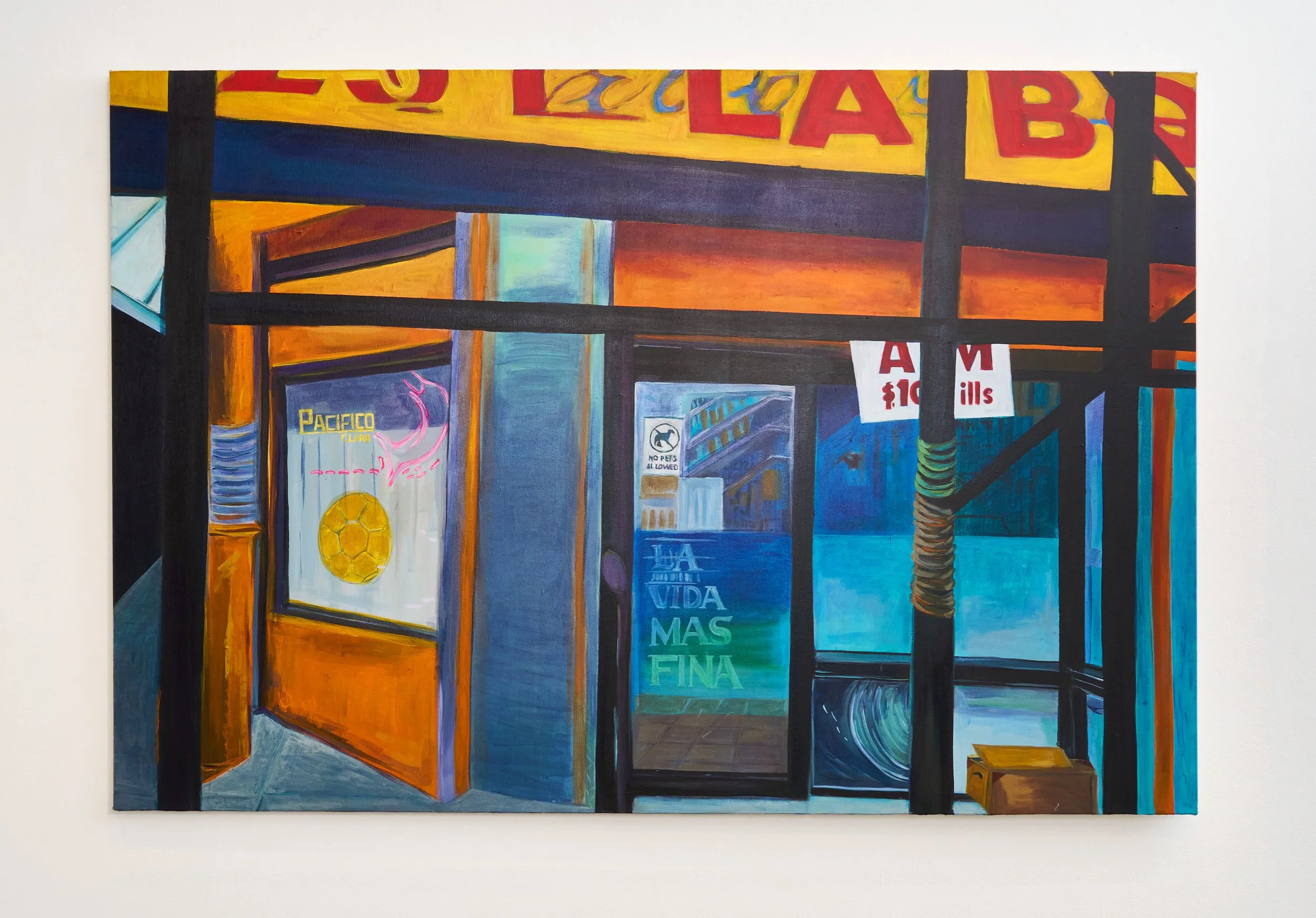
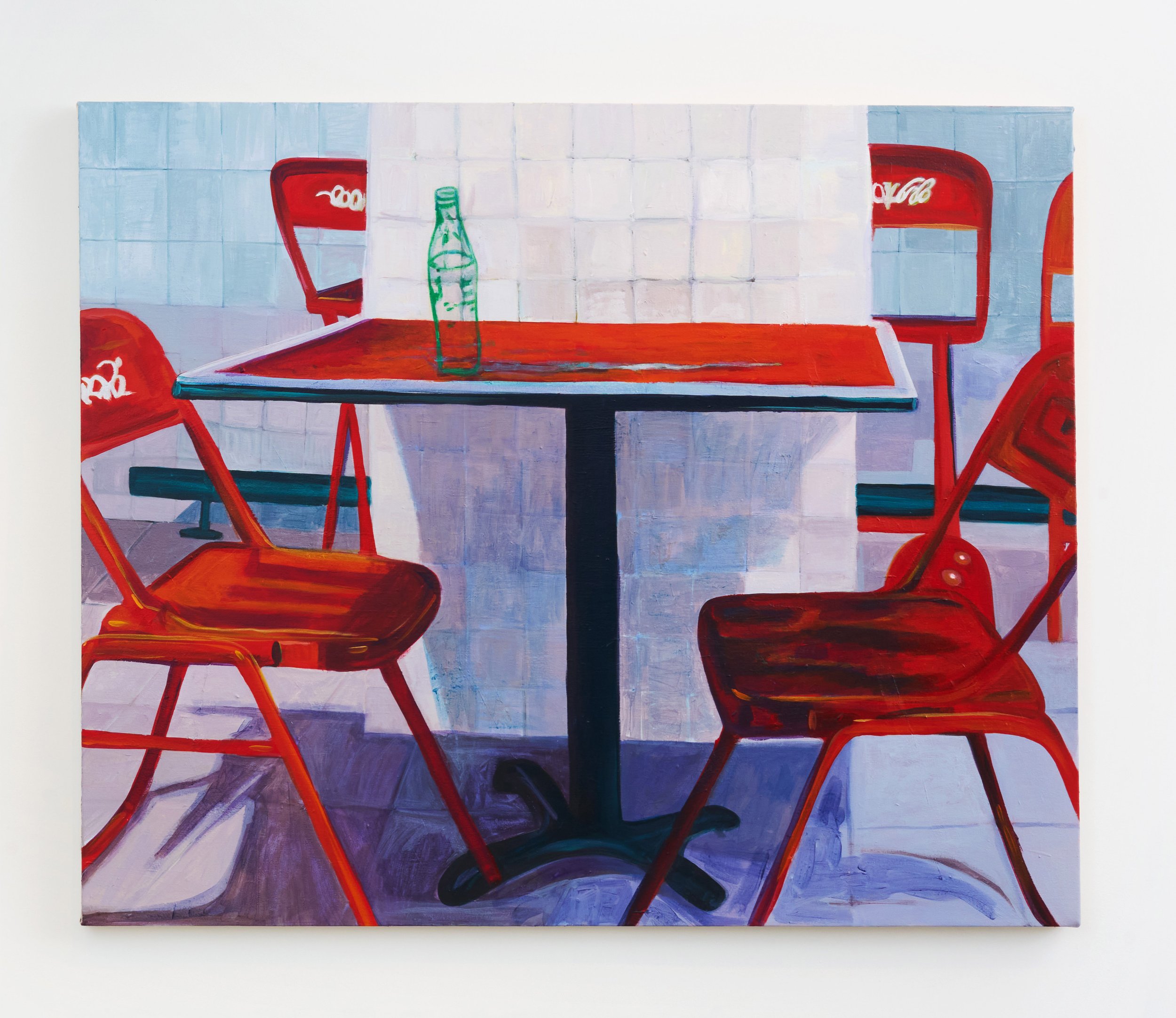
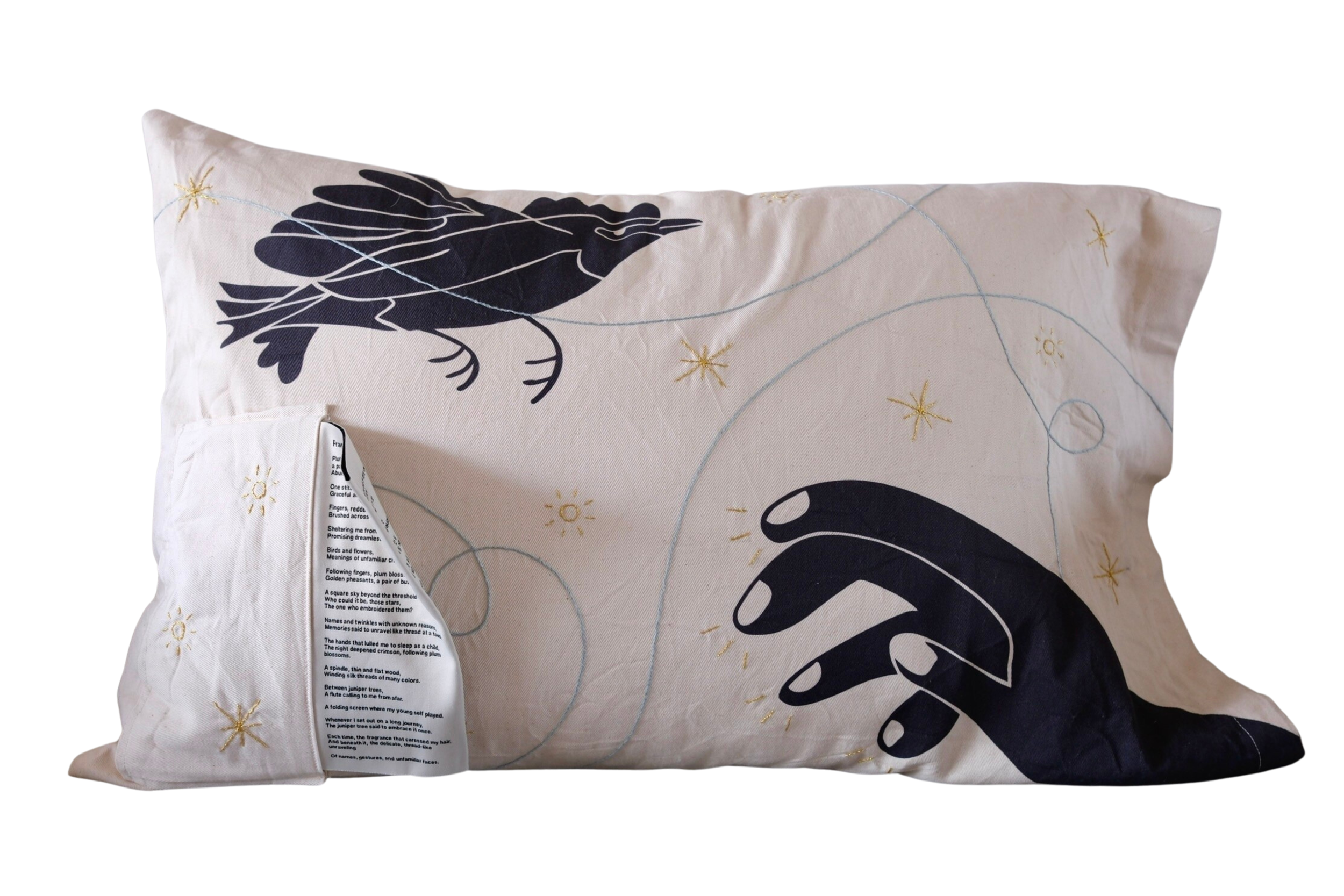
And our contributors have given us so much. Throughout the issue, you will find joys and offerings of all sorts. Selena Cisneros’ art brings this electric feeling of New York City to life, with scenes such as “Bodega on 119th St,” where Corona’s tagline “La Vida Mas Fina” (The Fine Life) is lettered in fine detail. The tables in her work point to the joy and importance of food and commonality, and most importantly, community, reflected in the call to action rendered in “La Morada”—“No Mass Deportations.” Nebras Hoviezavi hands us joy and grief in the form of growing and harvesting dates, while Anna Pinkas & Ham Jeong-jae merge crafts in a dreamy collaboration, reminding us of the simple joys of our senses.
Milk Press is also proud to feature for the second year in a row, the winners of PSNY’s 2026 Youth Poetry Contest, judged by superstar poet Annie Finch. We are thrilled to publish the works of young poets Anjali Natarajan, Madeline Berberian-Hutchinson, Yuhan Wu and Aisha Ali. This year’s theme, “Mythmaking and Spell-Casting,” brought young poets to create works that are part-prayer, part-invocation, and part-offering. First place winner Anjali Natarajan channels strength and power in “The Speaker Imagines Herself as Inanna Taking Control of Heaven,” writing “I’m seizing the reigns,” and “Splitting cloud cover / Cutting open dark sky” like lightning, breathing into the world “new life.”
They say you can’t catch lightning in a bottle, but you can certainly see where it struck, and know that it was felt by the land deeply. We can feel it in the air this summer. We can feel it in the streets. We feel it in this issue. No matter how big or small, old or young, this intersection of life, death, and all of the joy we can create before making it to the other side, is captured. And we hope you find as much joy in this issue as we have.
Our gift to you,
Leon Sebastian Barros
Natalee Cruz
Editors-in-Chief
Aisha Ali
LITANY OF SHIRK (BLACK GIRL MAGIC)
I am my self’s guest
There are the dead who light fires around the grave.
Then the ones who whisper to stones.
Then the ones who pray to stones.
Said: I am no mirage
Said: I am the mirage
Said: I am what is below God’s breast, do you pray to me?
Said: then, who heard?
Said: glad tidings, اَیَدِياَبِع , glad tidings.
Above me, a spectacle I was told only to watch. The sky, a penitent licking morsel, asking: is it time yet, am I to
fall, or collapse, am I alluring guests?
Our hands, fashioned from clay, testify against us.
No book of Jins, nor an unsurprising ode of black magic.
Woe to me.
I, alone, keep God’s name present.
I, alone, whither the violins, و mu’allaqat, و wadi, و sihr
and I lift it.
Woe to me.
Woe to the magicians.
Aisha Ali is a 16 year old Somali-American writer whose poetry explores religion, politics, and the experience of growing up between cultures. Her work reflects on identity and faith, and she hopes her writing sparks reflection and conversation.
Madeline Berberian-Hutchinson
COAT
The second dream I can remember was a flash of God in a fur coat.
But even pressed up against the back of my eyes, he had to hem it, that coat.
The first time we met she asked if her stinging nettle rash would heal faster if I licked it.
The poison covered her. She called it her coat.
Over her shoulders she slung her mother’s kitchen towel
(the same one she used to quiet the garage drumset) like a coat.
The chip of her front tooth winking at the split rim of the bowl,
She drank her soup with her hands, the spaces between her fingers covered in a split-pea coat.
Left on the bedside table: her springtime birthday, my solid oak birdhouse, her goosebumps,
my ingrown toenail, her tarnished eyelets, and her shoelaces over my unfastened coat.
She told me she would grow something new from the inside of her bone, or maybe mine.
I have never held palms so calloused. That ruptured skin, that anti-coat.
Early May slanted into the backyard and the root vegetables shriveled into sharpness.
My mom called me from across the country: “it's because of the yearlong frost. The ground’s coat.”
We laid perpendicular. When unbound, parallel.
Like zipper-edged, like skin-to-skin.
I was going to name the new foal after something vaguely ancient—like Jonah—
But her limbs hit a patch of cement and she suffocated on her amniotic coat.
We had to cut her out
Of her coat.
Madeline Berberian-Hutchinson is a poet and artist from Brooklyn, New York, studying Art History at Yale University. She was a 2023 NYS and NYC Youth Poet Laureate Finalist, and her work has been published by Girls Write Now, the New York Public Library, and Rough Cut Press. She has recently received awards for her poetry by The City College of New York, and the Scholastic Art and Writing Awards. She is the 2024 winner of the Young Armenian Poets Award and 92NY Teen Arts Award. She has performed at notable venues such as Federal Hall, The New York Public Library, and the Guggenheim Museum.
Selena Cisneros
THE BODEGA ON 119TH STREET
LA MORADA
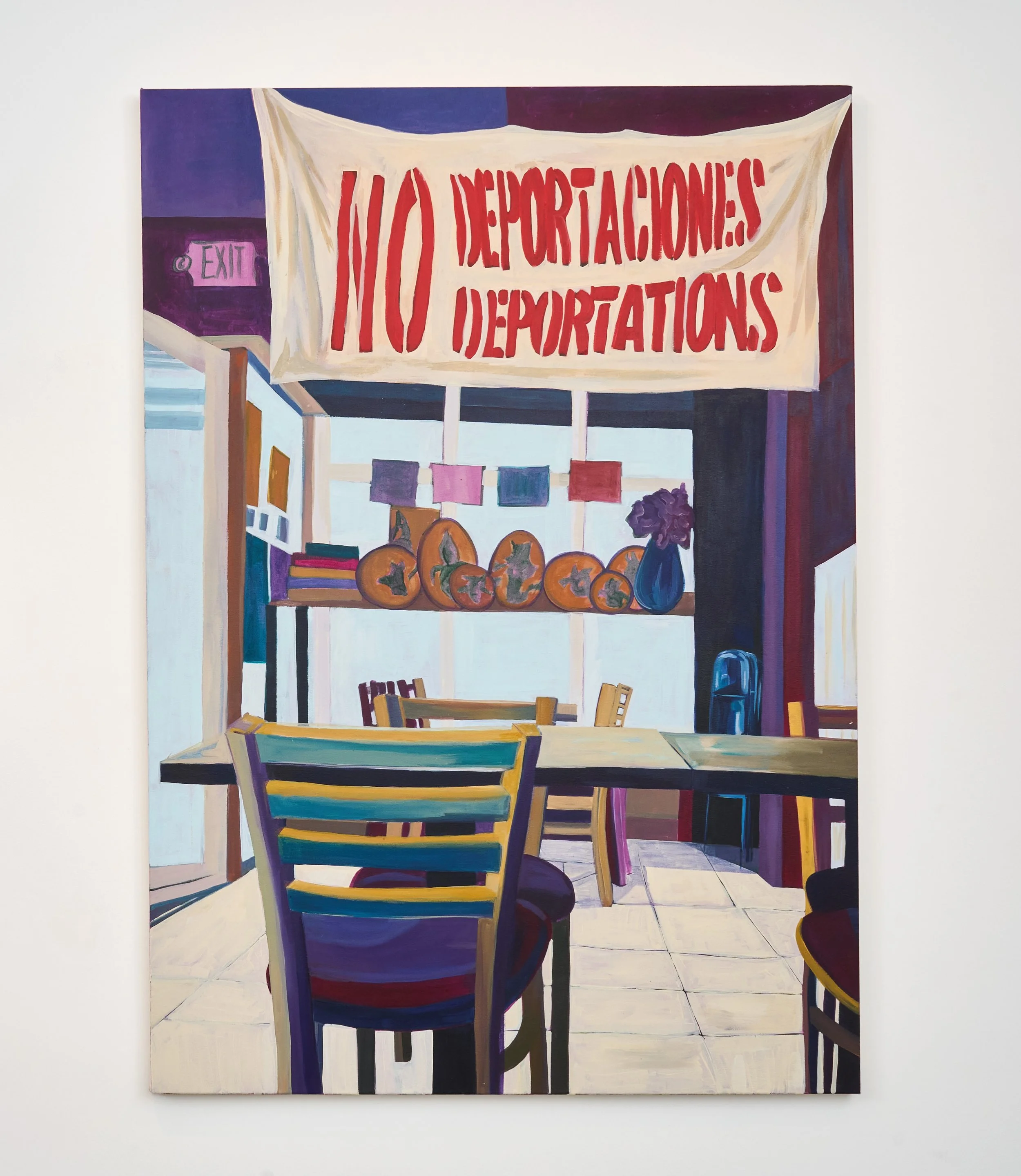
Selena Cisneros is a New York based artist, her practice delves into themes of transience, community, and the shifting geographies of the Mexican diaspora. Cisneros explores urban landscapes through both a micro and macro lens, highlighting the mundane, overlooked details of a space to capture the simultaneous absence and presence of community. Through painting and photography, she references local neighborhoods and places abroad that embody her upbringing. Focusing on gathering spaces—sites where people meet for a shared meal or assemble as a collective. Within this capacity, her work posits that home is a constructed idea and an ephemeral experience of community-building in places that are foreign.
TAQUERIA ORINOCO
BODEGA CAT
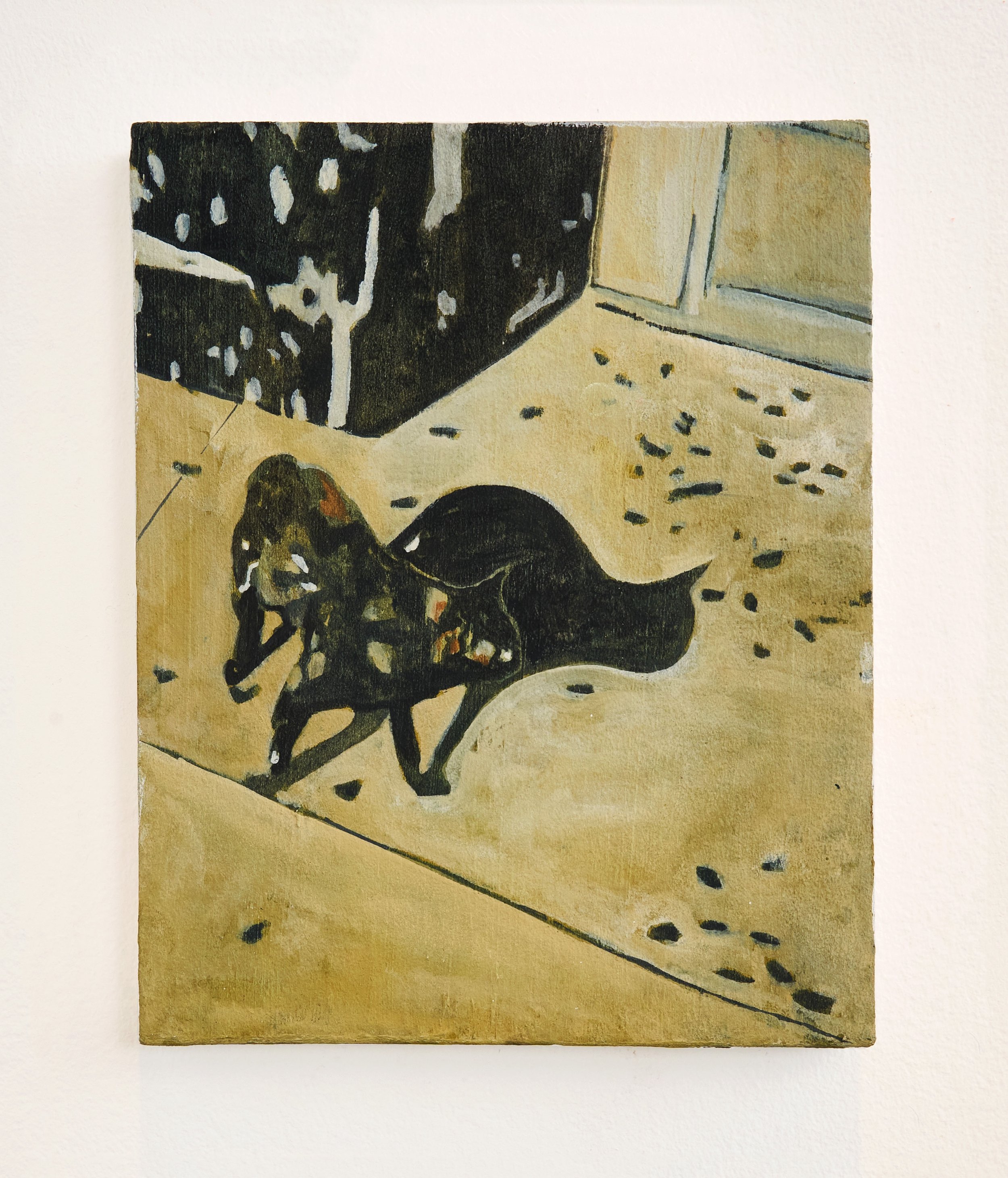
Selena Cisneros is a New York-based, first-generation Mexican-American artist and educator. She recently earned her MFA from Hunter College and received the Elizabeth Greenshields Foundation grant. Her multidisciplinary practice spans painting and mixed media to explore urban landscapes. Currently, she uses tactile materials to directly respond to and depict her community. Her artwork has been featured in numerous exhibitions throughout New York City.
Nebras Hoveizavi
Translated by Amirali Ghasemi &
Bahar Ahmadi Far
Will I become a palm tree,
a body scorched, scarred, aching?
A green head, shoulders heavy
with half-ripe dates.
In the searing season of ripening,
I sleep standing,
my feet on tiles,
a thin breath of air touching the ground.
The tower rises,
and grief still clings to my brown bones.
The wind and my hands arrange the branches,
hoping for rotab.
I give them rain.
At the end of a dusty road,
packed with clods of earth,
loud with unrest.
I do not give dates—
yet when I did,
I saw the harvesters claiming the palms,
conquering the trees
in the fever of half-ripe fruit.
They pour them
into green mesh sacks.
I wondered about the palms
along Umm al-Jawahir Street,
or Muhammad Bin Khalid Street.
But I did not sit to harvest rotab.
In this grove,
I refuse—
the bird shaking my shoulders,
this soil,
this water.
Sip by sip,
from the desert inside me,
now I want sweet violets.
If I produce rotab,
they will be red,
and in my courage,
they will catch fire.
I comb my hair every day,
still standing tall,
neatly aligned.
Among all the palms,
I stand in order.
We are the same color,
disciplined, systematic.
We are counted.
My name is One-Five-Forty.
The clerk below opens the ledger,
writes something down.
He calls out two people from a distance—
matching navy uniforms.
They run,
point to my head.
Perhaps I was given a bad name.
They cut my green hair
to make a kapu basket.
But what use is a green basket
When the curse of the tree
is to bear rotab?
I gave rotab leafless,
not your share.
The birds ate them.
Bless them.
May the sweetness of dates
warm their bodies.
WILL I BECOME A PALM TREE
Nebras Hoveizavi (b. Ahvaz, Iran) is an Arab-Iranian poet, artist, and educator. Originally trained as a poet writing in Farsi, her migration led her to develop a visual language where images function as a form of poetry and now, language and image are finding their way back to each other. Her work explores displacement, memory, borders, and the limits of language, often reflecting on the tension between familiarity and estrangement. She holds a B.F.A. and M.F.A. in Photo/Media from the California Institute of the Arts and is currently based in Qatar, where she teaches film and photography. Her work has been exhibited internationally, including at the Whitechapel Gallery (London). She is currently developing poetry and short stories alongside her visual practice.
Laura Kolbe
There must have been a party
to warrant this rose balloon
tied to my wrist.
Pink and plinking, half
aloft demanding
a volley of touches just to stay
up. Yesterday surely –
paper table cloths and cake
crumbing, stereo playlist
marcelled across rolled rugs –
party was? I raise
my hand to ask – the glum sphere
grazes pinkly up the wall.
I usher spoon to mouth
to feed myself – the baggy ball
imposes on my nose.
It takes a craning canter
when he’s tuckered – and transfusion
of dignity from a me-part to a he-
-part for him still to be
balloony – no mere smear of air
in cheap rubber
cover. We make –
since which
event? – a kind of couple cinched
by wrist and ribbon
taking together the air –
this window cracked
to breeze our cheeks.
These finchy yellow patches
on the kitchen tile where
milk has slopped like beer.
A here and yellow there.
There must have been
a parting where the boom box
and the cocktails left
and guests dug out a snowpath
to boot themselves away.
Balloon and me, puzzle
in which two toys lock,
bob clockily. Sun’s
already down again.
As lightness slowly leaves us
and we swim the ruggy static
I recall – the gleaming mop
and almond air of expectation,
the purchased nibbles, sodas,
wines and woofer. The door unlocked
and note about the buzzer.
Then screen goes black
and I – balloon-brain – muzzle
chairleg with my face.
The tin ceiling spreads
as though a sea below. A stamp,
a stomped before. False floor.
Small balloon, you partner mine,
you baby breathing smaller
than a mouse – my kingdom
for a house without confusion!
– orient and corporate
our beings, being
air in some part and in others
matter of a thicker, duller
kind and I am fullblown desperate
to remember –
love – in un-inert un-thingy
drafts of warmth – some gyre to cling
to – rings or rungs to –
bear us up.
PARTY
EAST OF THE FIRES
Under the scaffolds
painted green like flat,
theatrical trees – one pink, wet
nestling on the sidewalk, soft
and scrunched like a quarter-note
rest, soft save
for caliper beak
and talons smaller than rice.
The sky today the color of that,
of unidentifiable – maybe robin,
jay, maybe last
of some strain, a week old,
who knows, a tented skin
of froth-milk grey
and clay-urn tones
where muscle bundles
enzyme-tenderize
beneath scant fat.
And I, carrying
a helplessness inside me,
a gruel of growth breathing
smoke from my blood.
The sky today the color of that.
A juvenile flipped
aground, out of one and onto
another larger, harder
broken shell. Thank
God, it wasn’t moving.
Laura Kolbe's poems have appeared in The Baffler, Conjunctions, Harper’s, n+1, The Nation, The New York Review of Books, The New Yorker, Poetry, The Yale Review, and elsewhere. Her first collection, Little Pharma, won the Agnes Lynch Starrett Prize in 2021. Her next book, The Decadent Movement, is forthcoming in September.
Anjali Natarajan
THE SPEAKER IMAGINES HERSELF AS INANNA TAKING CONTROL OF HEAVEN
“When [they] dreamed of settlers... they dreamed only in white.”— Jason Pierce, Making the White Man’s West
Night ends somewhere / Between me and God
Dreamt in white / It’s just a little thing
I’m a child I say / It’s inconsequential
It is tender / It is violence
I am surfacing through watery depths / I am asking if you’re there
I am gasping for breath / Mouth forming around the shape of the bullet
I spit it out / I write your name on clay tablets
I call for help in the darkness / I’m calling for you on dredge stones
I’m gonna be an adult soon / I tell you but you don’t answer
And you’re brutalizing me / I am screaming your name
My classmates cry out / It melts into the walls
The news flashes with ICE, snow, sleet / Cold tangles in my hair like rivers
Even with my mom’s arms around me / I am still scared
& she had more rights than I did at seventeen / My laws have to be different
School door open-streaming out protest / I’m seizing the reigns
When I fight for this place I will / When I transform this land I will
Breath in gulps for our smooth throats / Pierce the sky
Brown skin, black skin, gold light, honey / Needle-scissors, mother, nettle
Open-mouthed, streaming, invoking / Splitting cloud cover
Cutting open dark sky / Dreaming into every pink, red, all color, new life
Anjali Natarajan is a Black/Indian-American student from Austin, TX. She has received fellowships, residencies, and support the Austin Public Library, the City of Austin, and the East Coast Asian American Student Union, among others. She is an alumna of the Kenyon Young Writers Workshop and the Sunhouse Mentorship. Aside from writing, she enjoys watching world cinema, taking double-exposed photography, and playing video games. She strongly believes in the power of the arts as a means for social and political advocacy.
Anna Pinkas &
Ham Jeong-Jae
FRAGRANCE
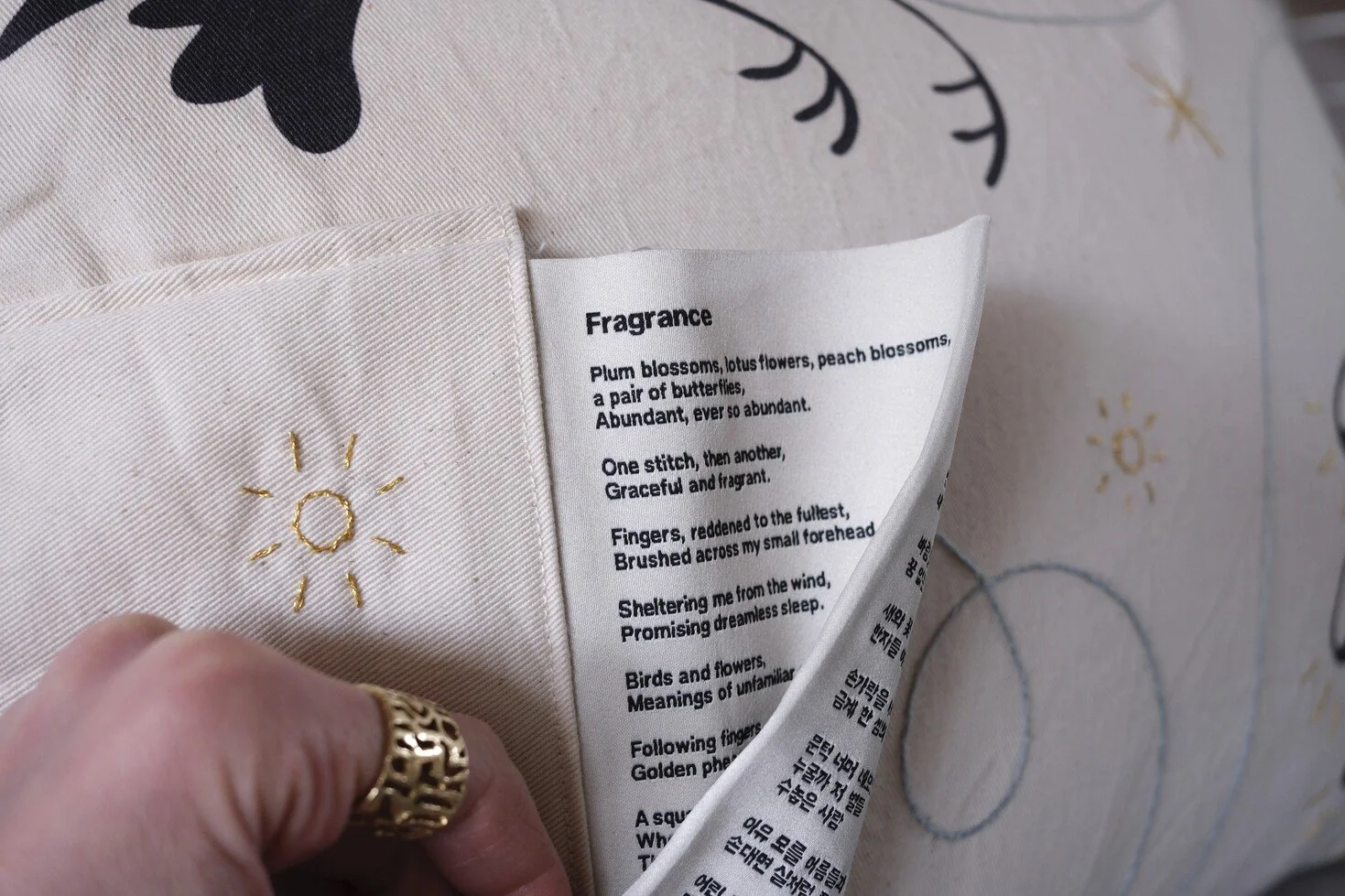
FRAGRANCE
Plum blossoms, lotus flowers, peach blossoms, a pair of butterflies,
Abundant, ever so abundant.
One stitch, then another,
Graceful and fragrant.
Fingers, reddened to the fullest,
Brushed across my small forehead,
Sheltering me from the wind,
Promising dreamless sleep.
Birds and flowers,
Meanings of unfamiliar characters and names.
Following fingers, plum blossoms,
Golden pheasants, a pair of butterflies.
A square sky beyond the threshold—
Who could it be, those stars,
The one who embroidered them?
Names and twinkles with unknown reasons,
Memories said to unravel like thread at a touch.
The hands that lulled me to sleep as a child,
The night deepened crimson, following plum blossoms.
A spindle, thin and flat wood,
Winding silk threads of many colors.
Between juniper trees,
A flute calling to me from afar.
A folding screen where my young self played.
Whenever I set out on a long journey,
The juniper tree said to embrace it once.
Each time, the fragrance that caressed my hair,
And beneath it, the delicate, thread-like unraveling
Of names, gestures, and unfamiliar faces.
향 - 함정재
매화 연꽃 복숭아꽃 한 쌍의 나비
다복하게 다복하게
한 땀 그 위로 또 한 땀
유연하고 향기롭게
한껏 붉어진 손가락
내 작은 이마를 쓸어내리던
바람을 막아주던 폭
꿈 없는 잠이 될 거라고
새와 꽃 뜻 모를
한자들 이름들
손가락을 따라가면 매화
금계 한 쌍의 나비
문턱 너머 네모난 하늘
누굴까 저 별들
수놓은 사람
이유 모를 이름들과 반짝임
손대면 실처럼 풀어진다던 기억은
어린 나를 재우던 손짓
매화 따라 붉게 깊어지는 밤
실패는 얇고 편편한 나무
색색의 명주실을 감아두는 것이라고
향나무 사이로 부는
멀리서 나를 부르는 피리 소리
어린 내가 노니던 병풍
멀리 떠날 때면 한 번
안아주고 가라던 향나무
그때마다 내 머리를 쓰다듬던 향
그 아래 실처럼 풀어지던 고운
이름들 손짓들 본 적 없는 얼굴들
Ham Jeong-jae is a poet based in Seoul, Korea.
Anna Pinkas is a visual artist who collects mundane details to find beauty and whimsy in our everyday life. Digital tools are essential to her practice (whether it be for capturing reference material, animating, or preparing files for printing), but she also strives to move away from screens by creating tangible, playful objects. Collaborative practices play an important role in her work - generating content through community workshops, or collaborating with other artists on certain projects. Traditional animation (which she studied extensively and teaches) influences her sequential approach: she often works in series and with the book format to surface the strange and beautiful qualities of common behaviors and objects.
Anna was born in Geneva, Switzerland (1985). She lives and works in Brooklyn, NY. She is a full time professor at the Borough of Manhattan Community College’s Media Arts & Technology department. More of her work can be seen at www.annapinkas.com
Addie Tsai
DOUBLE EXPOSURE
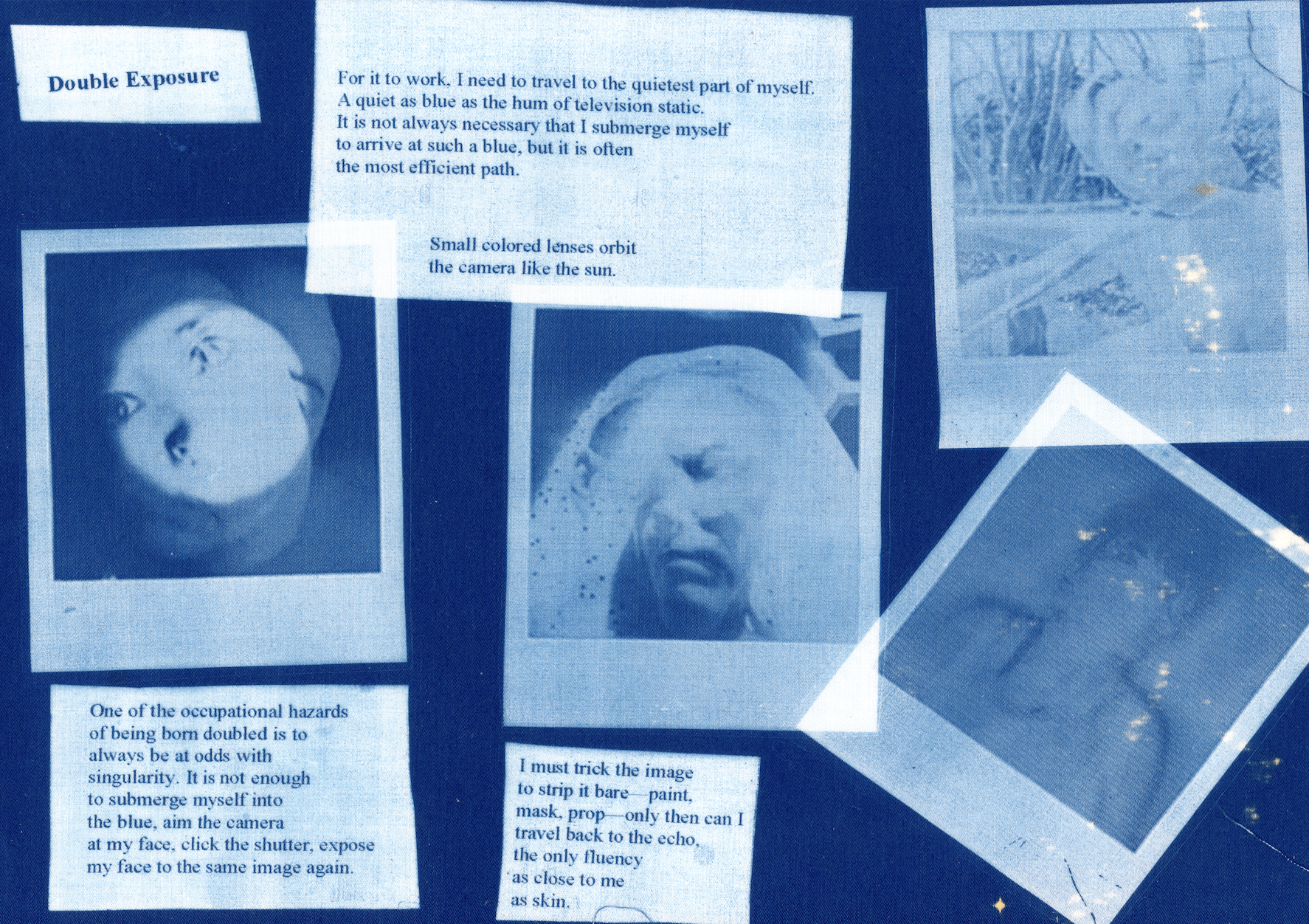
FAILING MANDARIN
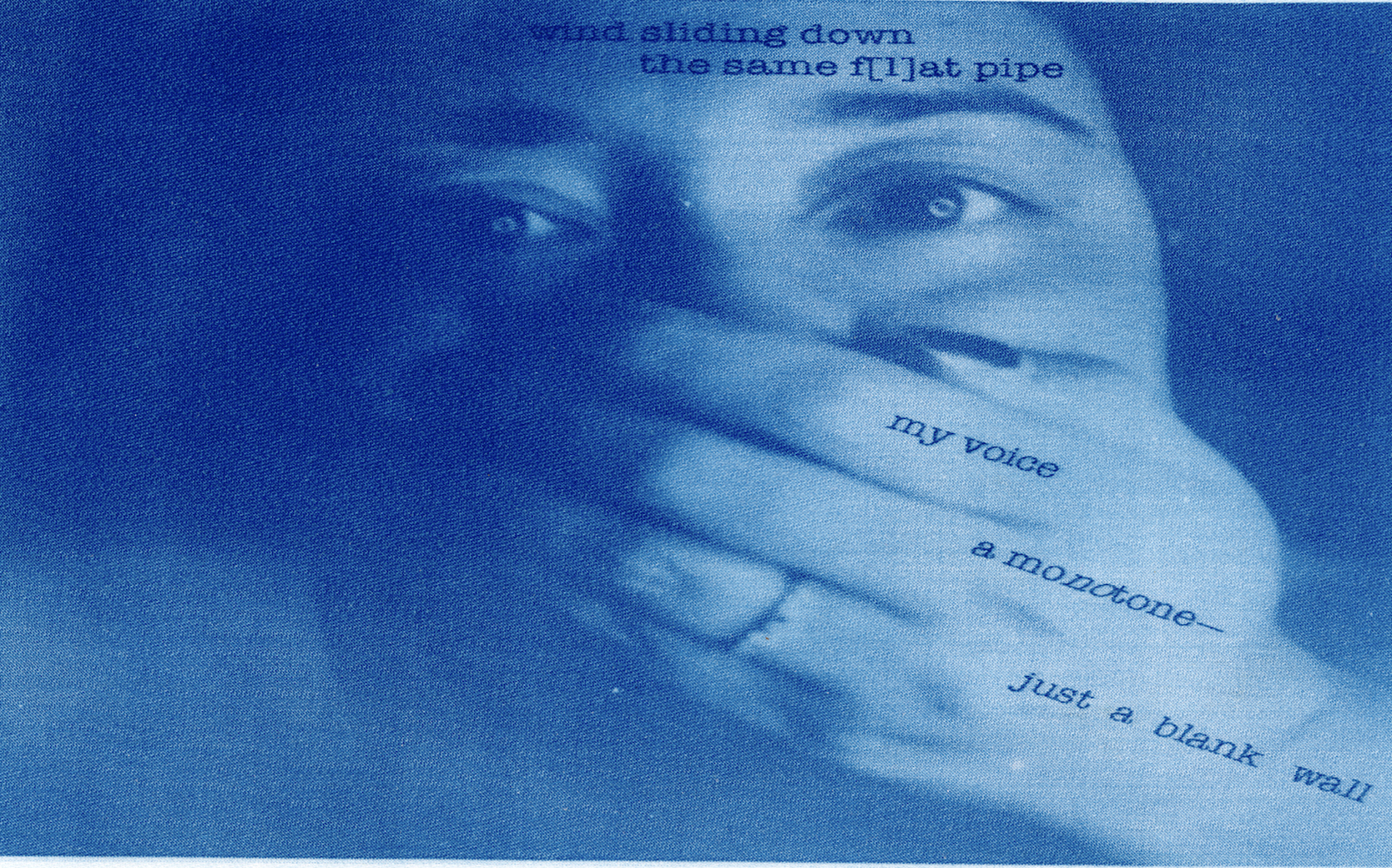
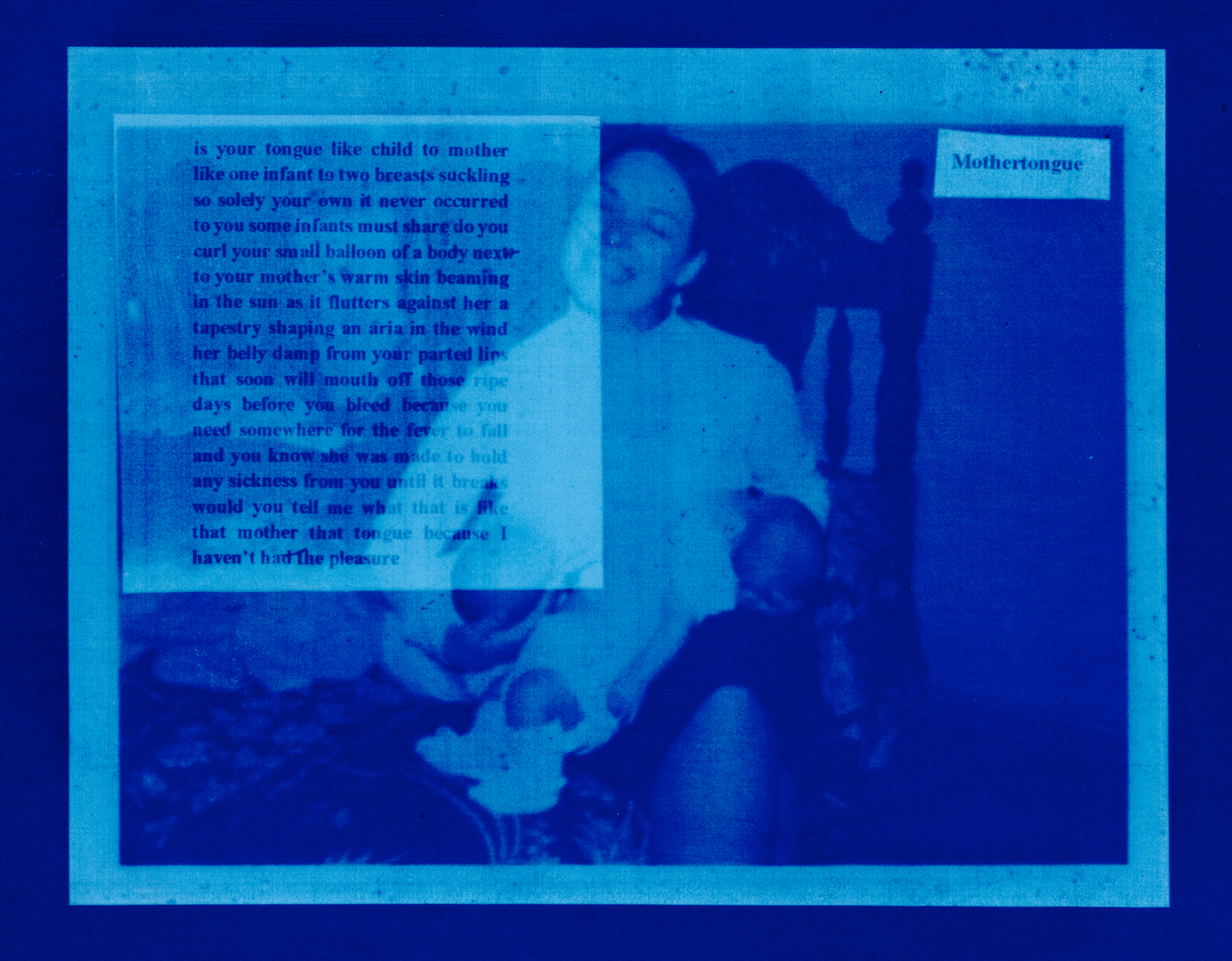
In these cyanopoems, I weave together process, medium, and form to explore questions of self, language, twinhood, and identity. In both “Double Exposure” and “Mothertongue,” I exposed cut pieces of text over the central image/s in the alternative process of the cyanotype, creating their own double exposures. I consider “Double Exposure” a triple exposure, as the text was exposed in the cyanotype process on top of a canvas of multiple double exposures taken with a hybrid Polaroid camera. The double exposure layered with poetry expresses the dualities I experience as an identical twin and an Asian-American. Printed on fabric, these pieces blur the boundaries between print, textile, poem, and broadside as they collage the historic and contemporary traditions of cyanotype, double exposure, Polaroid, and digital photography.
MOTHERTONGUE
Addie Tsai (she/they) is the author of Dear Twin (2019), included in American Library Association’s Rainbow List in 2021; Unwieldy Creatures (2022), a Shirley Jackson finalist for Best Novel; and Straight White Men Can’t Dance: American Masculinity in Film and Popular Culture (2025). She collaborated with Dominic Walsh Dance Theater on Victor Frankenstein and Camille Claudel, among others. They are the founding editor in chief for just femme + dandy. Addie is an Associate Teaching Professor of Creative Writing at William & Mary.
Yuhan Wu
TRIPTYCH FOR THREE GENERATIONS OF CHINESE DAUGHTERS
I. 外婆
every chinese daughter begins
with hunger. wàipó learned
her mouth was not made to speak,
so she minced her words into
pork broth boiled thin, marrow-less
bones sucked hollow by men with
god-hands. lips greased, dripping. like every
good daughter, she lowers her eyes dog-
eared and lays the bowl before
father and brothers first, for
son wins 尊 while daughter bears 卑.
when she birthed a girl she wept, the
slick red lump a curse smeared
against her jutted ribs. she bit
the cord, clawing her way out
of the scarred walls of this village
to build a life from rubble
in the city, so this screaming debt
clutching against her breasts could rise
from the dirt that caked the ankles
of every woman before.
when her daughter swelled with child,
wàipó clasped her hands, god pray
it be a boy, and knelt under the mildew-
cracked ceiling, because a girl would carry
the same wound, the same shame
branded into her skin. the white
hospital lights descended like buzzing
locusts and swarmed her body,
prayers rotting to dust before
they hit the floor.
II. 母亲
every chinese daughter begins
with hunger. bamboo poles strain under
laundry swaying in smog-choked air.
mother runs through the city that devours
its own daughters. she is barefoot, gravel
cutting into heels, arms thrashing as if
to tear open a mouth of sky. she bends
over borrowed books like a sickle, chasing
the luminous horizon that keeps receding,
each book a rusted rung of ladder
no one has survived climbing —
女大当嫁 four words hammered across
the threshold, pinned on the red silk of
a bridal veil. face erased, candle drowned
in smoke. for who is she when the last
firecracker shrivels to ash and night
drops its heavy curtain, when voices of men
thunder through the house. dishwater
scalding cuticles, the smell of garlic
burrowing into pores. she stitches
her dreams into quilts and folds them
each morning, smoothing until they lie
flat and silent.
III. 女儿
every chinese daughter begins
with hunger. but I refuse
The ending. I was never taught
to bow my head or flinch before
rules of silence. in the shanghai
airport my mother pressed her mouth
against my ear and whispered, you
will do what we could not.
and as the plane lunges skyward
I feel the tug of generations
of calloused hands braided
under my soles, a lattice of tendon, bone,
tendon, prayer, layered like sediment,
scaffolding me upward into spaces
they were denied. I am trembling,
I am soft, I am first in line to taste
the contraband freedom they carried
like fire in their veins, and I refuse
to starve. I open my mouth and devour
whole the bargains of dowries,
the arranged marriages my wàipó
could not refuse, mother’s shadow ladled
into soup bowls. the silk that bound
wàipó’s feet is unraveling into rivers
flooding the streets, veils ignite
into constellations, burning through
the ceiling. their silence bursts
inside my throat like glass, jagged and
crystalline, refracting the voices they
were denied. the hunger of three generations
of women,
of wǒmen,
of 我们.
Translation:
尊:Honor
卑:Inferiority
女大当嫁:A Chinese proverb meaning a girl of age ought to get married.
我们:Us
Yuhan Wu is a writer from Shanghai currently residing in New York. Her work is published or forthcoming in Aster Lit, Apricity Magazine, Eunoia Review, amongst others. She has been recognized by Smith College, Hollins University, The New York Times, and the National Scholastic Art & Writing Awards.
Marsha Yi Robinson
WHEN ALL THERE IS LEFT IS LONGING
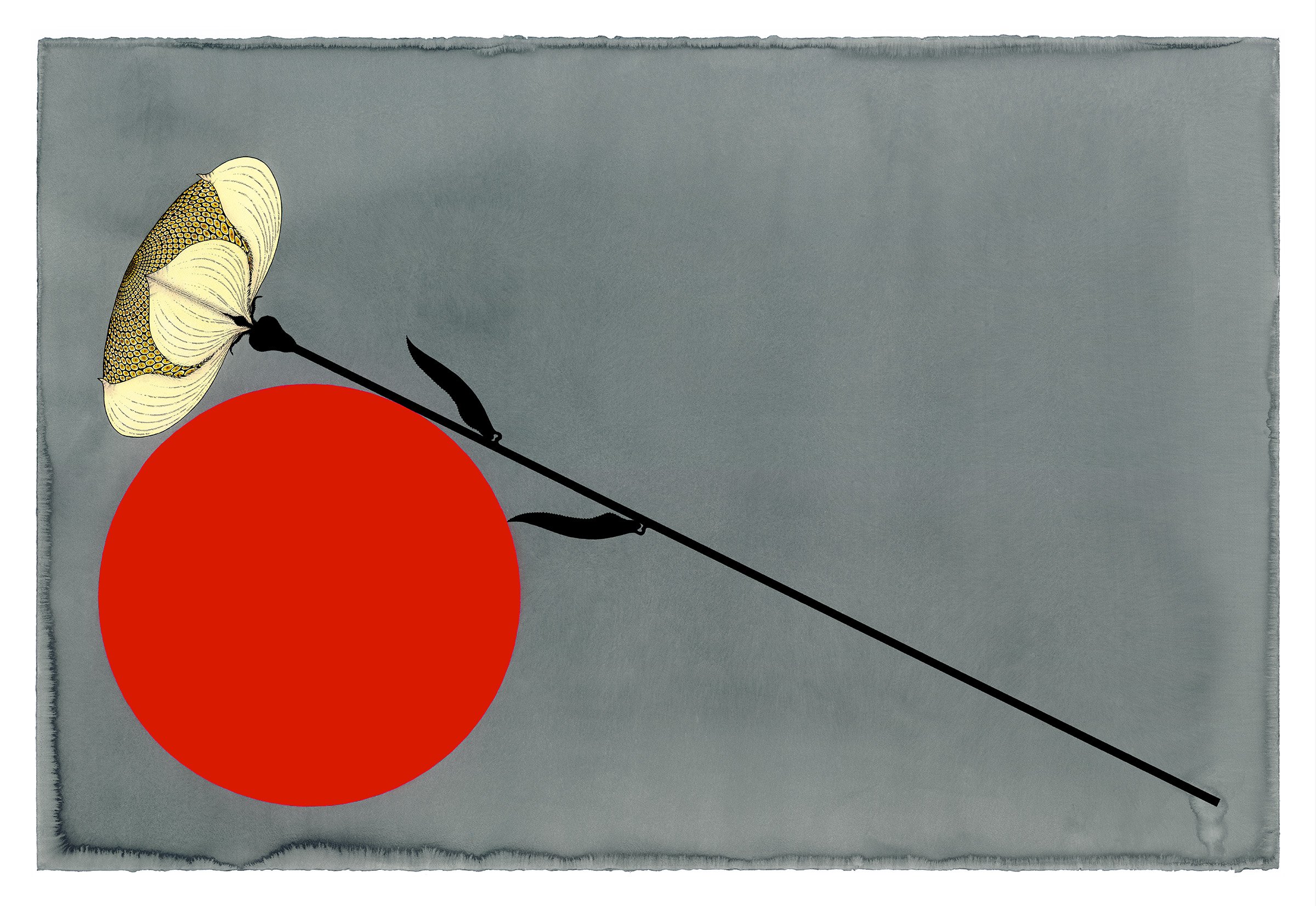
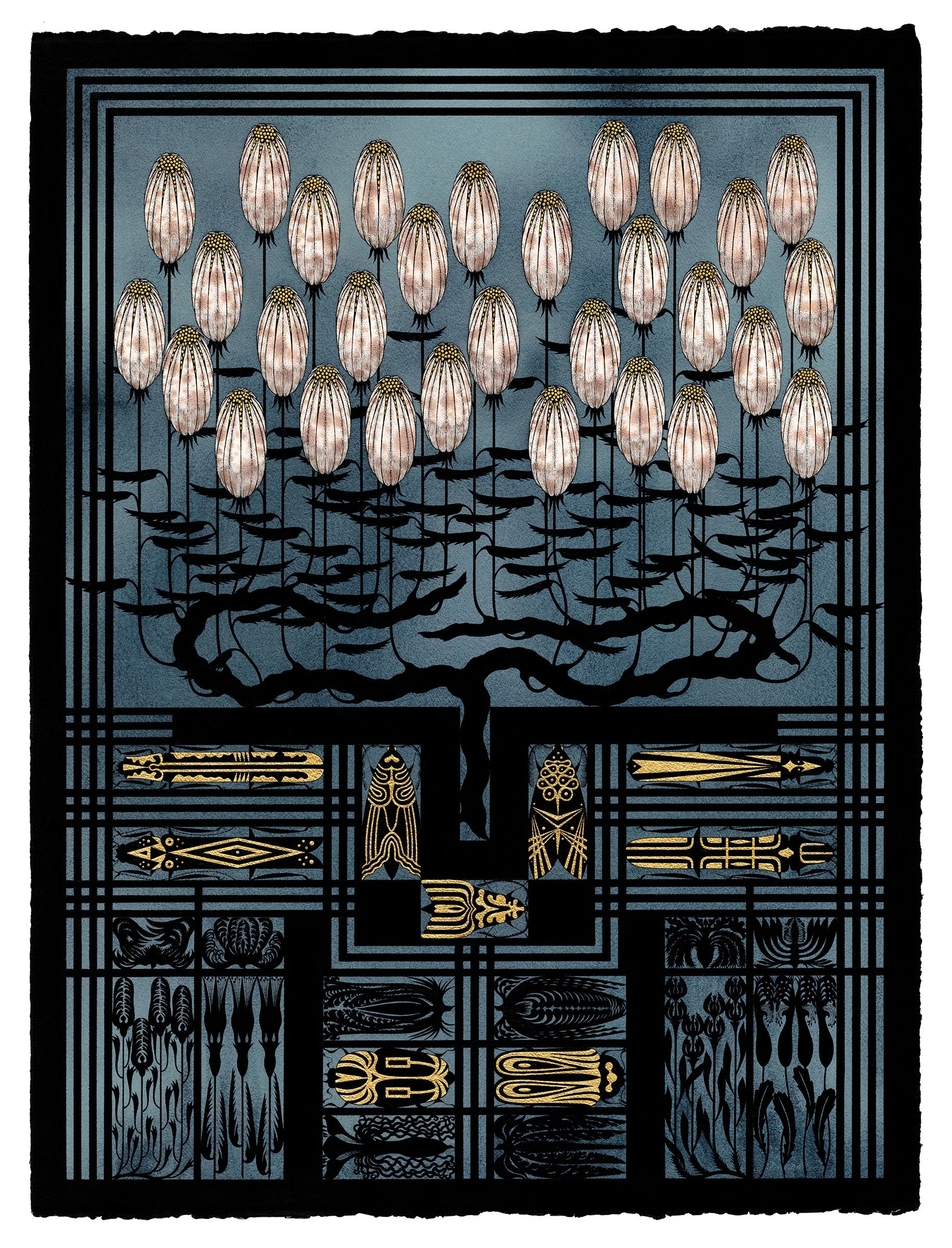
BLUE SUMMER
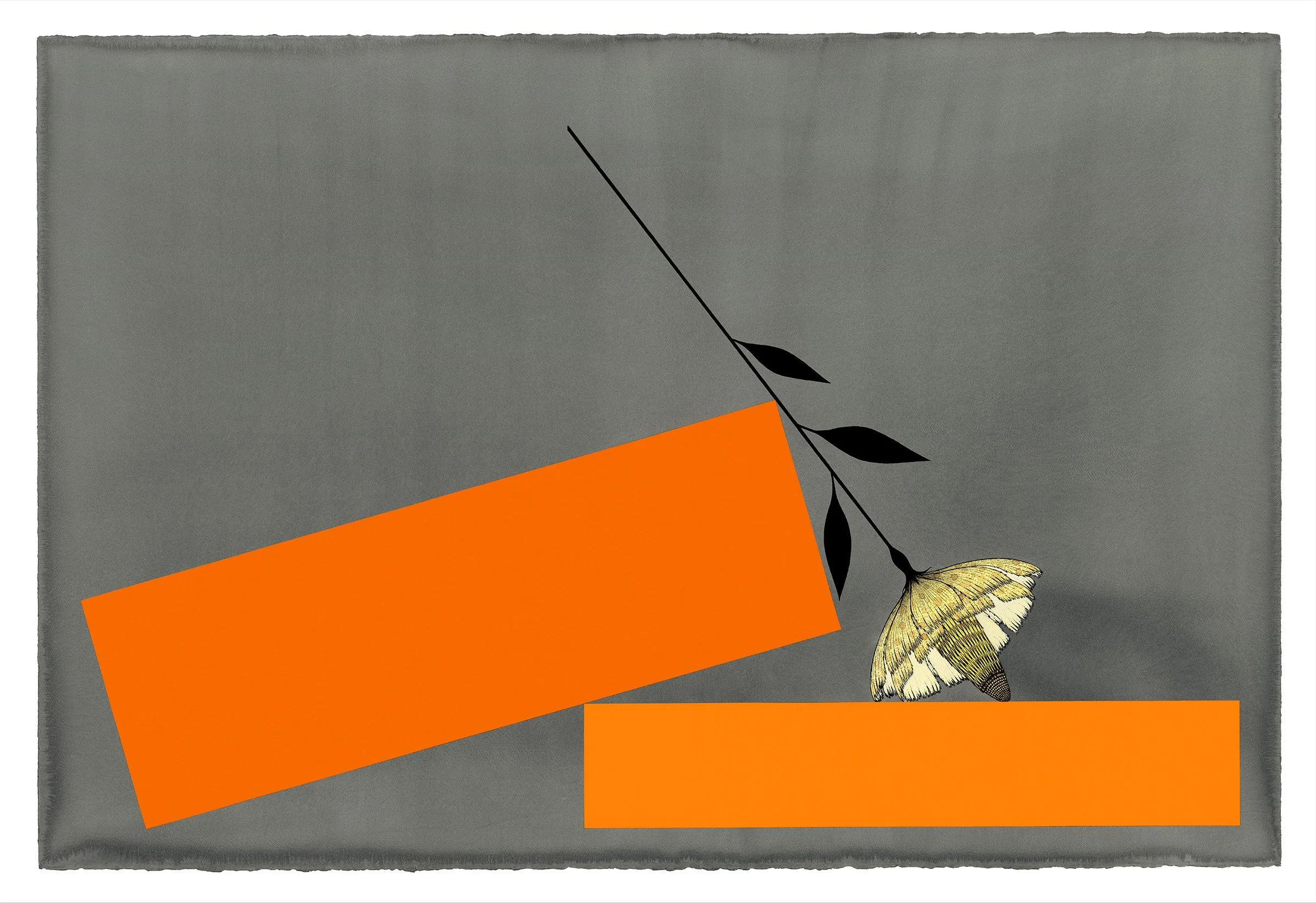
DESIRE
MarSha Yi Robinson is a self-taught artist who was born in Seoul, Korea; raised in both New York and Los Angeles; and currently lives in the Southwest. Her artwork—hand-drawn and primarily using India ink—combines both floral and geometric structures. The contrast between the floral and geometric produces a dynamic tension that troubles binary relationships, such as feminine/masculine, hard/soft, and organic/synthetic. In doing so, her paintings challenge commonplace notions of floral beauty, expanding botanical aesthetics and concepts into more diverse and nuanced territory. Since 2014, Robinson created and sold her original works and fine art prints as Strange Dirt.
F.M. Papaz
BOOK REVIEW
The Expansive Generosity of Arthur Sze’s Transient Worlds
“The more you give, the more everyone has” - Arthur Sze, Transient Worlds
Close your eyes and imagine a translator. Are they male? Undoubtedly. Are they white? Most likely! Are they someone you’d be excited to grab a drink with? I’m gonna guess, probably not.
In 2026, we are still in the throes of decolonizing our literary canon. The genre of translation is a critical frontier in this campaign, and it’s one that America’s most recently appointed Poet Laureate, Arthur Sze, tackles with his latest book Transient Worlds: On Translating Poetry, published by Copper Canyon Press.
Arthur Sze is the seventh bilingual poet in the title’s United States history and only the 5th second-generation American to hold the position. Transient Worlds presents a vision of translated poetry that is expansive in audience, form, epoch and cultural background. Sze splits the book into fifteen Zones and each Zone is dedicated to a different non-Anglophone poet, whose original poetry is accompanied by English translations,a biography of the poet, the selections, as well as the process of each translation.
Its expansiveness in regard to audience is established in Zone 1; in it, Sze transliterates a poem from early 400’s Chinese poet Tao Qian, providing the original Chinese characters, the Pinyin phonetic translation and the words in English under each character. Sze then invites the reader to create their own translation. This invitation immediately debunks the presupposition about who can participate in the appreciation or creation of translation– namely, those that are proficient in the language being translated. As a translator myself, in a language where my fluency isn’t complete, this was a groundbreaking moment to receive from someone as practiced and proficient in translation as Arthur Sze.
In the book’s introduction, Sze shares a time when he invited his Native students at the Institute of American Indian Arts to translate ancient Chinese poems into English, it was not only creativity-sparking, but “crucial in helping students develop their own voices and visions as poets writing in English.” In this way, his intention for the collection is “as a guide for widening and deepening the appreciation of poetry through the lens of translation.”
Zone 2 reinforces capaciousness with a visual poem selection that fills the page with a single compound word from Navajo (Diné) poet Orlando White. It is a compound word that holds untranslatable vastness, “a vision of the cosmos, of all that exists” and of the interconnectedness between spiritual and physical realms.
This initiates Sze’s expansive view of poetic forms, complemented by selections such as Guillame Apollinaire’s visual poem The Carnation, which he uses to remind us that “a poet is, etymologically, a maker.” Thus, a poet’s creative play and humor, as displayed by Apollinaire, is just as valid in “creat[ing] a moment in time” within a poem, as the more structured forms we can sometimes privilege as more ‘skillful’ or valid demonstrations of poetic prowess. In this, Sze forges another crack in conceptions of poetry and translation as stagnant or straight-forward, opening us up to a wider spectrum of possibilities in these genres.
In Zone 14, Sze develops his ideas on form in a discussion with Chloe Martinez on her translations of Mirabai, a Rajput, Northern princess and mystic poet. Martinez describes how her role as translated evolved throughout years of working with Mirabai’s poetry; eventually, she saw herself “less like a xerox machine, more like a singer interpreting a song.” This resulted in the choice to retain the original’s formal constraint of couplets, while incorporating contemporary language that elicits the intimacy between Krishna and Mira, the speaker of the poems. From ‘Mira Wears God’s Clothes’:
My teachers, it’s so hard to be conventional! How to even explain?
Mira says, what if I met with my mountain-lifting Lord
and stayed just like that, with him?
Transient Worlds enriches our understanding of history and culture through the lens of translation.
In Zone 9, Sze spotlights Song of Songs, romantic poetry from the Bible whose author is unknown. Alongside the original Hebrew, Sze includes an English translation from Jewish academic and poet Marcia Falk, as well as a secondary work by the Mayan mythic poet, Búffalo Conde—a persona of the Indigenous Mexican poet Pédro Perez Conde, whose work seeks to reconcile pre-Columbian Mesoamerican mythology with biblical texts.
Sze presents Búffalo Conde’s Song of Songs-inspired poem in native Tzeltal, in Spanish, and then the Spanish is translated into English by Michael Weigers. Here are the last lines of each iteration alongside each other:
"הַתְּאֵנָה חָנְטָה פַגֶּיהָ, וְהַגְּפָנִים סְמָדַר נָתְנוּ רֵיחַ; קוּמִי לְכִי־לָךְ רַעְיָתִי יָפָתִי וּלְכִי־לָךְ."
“Come with me,
my love,
come away”
“ja / sk’op jmamalal te ya x-ik’ awan”
“Es la voz de mi esposo que llama”
“It is the voice of my husband that calls”
Sze exhibits how, in translation, “lines of authenticity and originality become blurred,” how translation can be “a subversive act that undercuts colonial borders” and how its “blend of culture as [language] move across and transcend them.”
This achievement of Transient Worlds is easy to miss—underneath the valuable craft lessons and the beauty of his selections, Sze’s work has an unmistakable, decolonial infrastructure. So often, the translations most amplified in literary spaces contain existential generalities like romance and pain, expressed in ways that do not prick the conscience of the Westernized mind. Rarely is the English reader engaging with the poetry of abolitionists or exiles, of those that seek to eradicate the exploitative systems that built the nations we inhabit.
In the last few Zones of the book, Sze includes the work of Aimé Césaire and Najwan Darwish. Aimé Césaire’s French is one marked deeply by colonization; as a poet whose literary life was never divorced from activism, his foundational role in the Négritude literary movement became a stepping stone into political life, where he not only abolished Martinique’s status as a French colony, but became its President. So, Sze is not exaggerating when he comments that Césaire’s linguistic choice to incorporate Bantu surrealism into his poems, is work that “demolishes hierarchy" and centers the heart over a (Western) mind that seeks to control. From Serpent Sun, translated by Clayton Eshleman and Annette Smith:
the water raises the carcasses of light lost in the pompless corridor
whirlwinds of ice floes halo the streaming hearts of ravens
our hearts
is the voice of tamed thunderbolts turning on their cracked hinges
Césaire’s poetry in translation is followed by the Arabic of Najwan Darwish, a Jerusalem-born, Palestinian poet. The translation of his poem We Never Stop by Kareem James Abu-Zeid reads:
The people had a single country,
mine multiplied in loss,
renewed itself in absence.
Its roots, like mine, are water:
If it stops it withers,
if it stops it dies.
Sze remarks on how this poem “transcends the context it was written in…the speaker of the poem and the country are always in tension, always running.”
When I translate the poetry of C.P Cavafy, which often exists in a tight, single-stanza block, my inclination is to break open the form so the depth of the language can breathe. Sometimes, as I’m experimenting during the drafting stage, I can hear this uninvited voice, the voice whom Anton Hur refers to as the “mythical English reader,” harangue me for messing so much with the original structure. I wonder what the mythical English reader would say about Alice Oswald’s book-length poem, Memorial, which is an excavation of Homer’s Iliad—they would probably have uninteresting things to say about it. Sze on the other hand, affirms Oswald’s work as an act of “transformation [that] breathe[s] life into the interstices of an ancient text.”
As a translator, these selections have liberated me to trust translation’s voluminosity – to shed notions of it as an academic process, and remember that poetry always asks for our creativity, wants it desperately.
Transient Worlds illustrates how translation is a stream that never runs dry, an “inter-pollinating” creature, a “vehicle” that helps us “awaken to the possibilities—and expand the resources—of our shared language.” Arthur Sze invites us into this expansive practice, to transcend genre, and to experience language’s generosity and its unending abundance.
Fi or F.M Papaz is a Greek-Australian poet, editor, translator and educator living in Brooklyn, New York. She is a graduate of the Brooklyn Writer's Foundry MFA Program and the Director of Client Services at the Poetry Society of New York, where she also teaches workshops and manages their literary journal, Milk Press. Find her @fmpapaz or at her website: fmpapaz.com
Haden Riles
BOOK REVIEW
Hass’s Curriculum
Let’s see, where to start?
Published by Copper Canyon Press in late spring, A Third Commonness is Robert Hass’s look-back gathering of “occasional prose.” A whole sheaf of starts, arranged in four movements, made of introductions, speeches, talks, and tributes spanning 1987 to 2025. Wallace Stevens provides the title and prime metaphor, his “river, an unnamed flowing,” while C.D. Wright anchors the project’s “curriculum” in naming as “a matter of faith.” If we take Wright’s cue that naming “endows material substance,” that “animals did not exist until Adam assigned them names,” then names are not just tags fastened to the ankle of every bird or placards posted beside minor differences in land formation. Our ability to relate, to draw a line between ourselves and the knowledge we’ve cultivated about the world, hinges on our attention. Hass follows this thought through many acts of introduction and reintroduction that loop around the same knot: once something has been named, whether it be the neglected poetries in the American canon or the crisis points of our ecosystems, we cannot glide past it in quite the same way. To turn away from a named thing is no longer simple ignorance. It is a choice. Its implication is ethical, and the book’s arrangement gives that implication room to gather.
Hass repurposes these moments from bothersome, secondary literary apparatuses into lessons of attention. He writes, “I got much of my education from reading essays and book reviews and the kinds of introductions specifically aimed at hungry young readers.” For Hass, introductions orient more than just the reading. They have the capacity to shape how we approach ourselves. An introduction to the Brothers Karamazov not only gave Hass “a new way of reading novels,” but made him question the kind of person he wanted to be.
In the opening chapter “Home Ground: Some Definitions,” Hass engages the act of naming “to provoke wonder at the relation of language to landscape,” since putting us in touch might “make us better stewards of this continent.” Steward is the watchword: stewards are responsible for what they tend. Home Ground’s soft-spoken series of definitions enact this, becoming a kind of “tone poem” on the way naming “marries us to the earth.” In “‘Song of Myself’: A Lexicon,” Hass turns to Whitman through the dictionaries Whitman himself used, tracing their definitions through usage and time. Each entry and each change across editions of Leaves of Grass demonstrates for the reader how “human beings have both described and invented the world in which they find themselves living.” If “Home Ground” suggests that land is inherited through names, the Whitman lexicon shows that language is also an inheritance, one that can be repositioned to “embody new thoughts.”
Barry Lopez and Gary Snyder stretch the point. “Assembling a record of the way language honors the land,” Hass writes in “Barry Lopez: Some Glimpses,” means attending to “the exactness and immense variety of human attempts to name what we see.” In Gary Snyder’s “Four Changes,” attention to “nature and wildness and wilderness” becomes a way to “serve the land more wisely” by thinking beyond surveyed and received political entities. Hass’s point moves beyond the idea that better words make better poems. Words, maps, categories—all shape our interactions with a world we often think we are merely describing. “If the North American continent is an ecosystem, then all the ways we have imagined it,” including its “maps, geographies, metaphors, mentalities… peoples, languages,” “are its cultural equivalent.” The land is inseparable from the ways it has been imagined, and our relationship with the imagination we’ve inherited has come with a cost. There is no part of the world now unaffected by human activity; insofar as nature means “those parts of the world not essentially affected by human activity,” “nature” is over. “Climate change, growing population, a rising tide of extinction among plants and animal species, the shrinking of the last wild places that harbored them…”—the garden “put into our keeping” is proving unmanageable because “managing” it is the failure in our understanding. Classification, writes Hass, requires attention to become knowledge. Attention isn’t just a poetic virtue, it’s an ethical one. Our misstep in seeing is that the words we use about the world condition the ways we interact with it. For Barry Lopez, “honoring the land” will hopefully “draw forth honor in us and our behaviors.” It is Hass’s hope that we can recover the responsibility obscured by the illusion that mapping and managing are equivalent to understanding.
Hass treats tradition the same way he treats landscape: as an inheritance. Tradition digs fence-posts and carves roads. It shapes a culture, its behaviors and its habits. Most of the time, we don’t know we’ve paired a compass with an incomplete map. If, as Hass writes, “our language… has been impoverished” by a cascade of received imagery and instruction, A Third Commonness keeps returning to such moments of attention, where re-seeing becomes a small act of change. If names teach us how to see, introductions teach us which way to go. Across the collection, Hass works outside the narrowest accounts of American poetry. In “The Library of Congress Lectures,” it is the “subjects that belong to American poetry and have, until recently, hovered around the edges of most of its traditions” whose language Hass aims to recover. To relearn these names is to practice a kind of accountability because how we have received something is not the same way we have to leave it.
But recovery has its limits. Each act of recovery is an act of selection. Orientation is never neutral. If every act of naming sets something apart, Wright’s epigraph cuts both ways: “horse, then, unhorses what is not horse.” Every selection is complicated by what it leaves out.
The problem doesn’t stay on the page. We can mark the condition of a landscape, re-orient ourselves to it, sure, but what do we do with this awareness once we have it? The stakes in seeing more clearly, attending, honoring are all well and good; the development of American ecopoetry shows to some degree our words can be the inspiration for concrete, legislative change. The open-handedness Hass cultivates throughout A Third Commonness—a gesture of patient goodwill, even kindness—is an offering as much as it is a limitation. If it can’t close into a fist, to defend or demand, it isn’t any clearer what that preparation was for. In the face of ecological collapse, resurging totalitarianism, and however many other lowercase crises, kindness and generosity find little purchase. This re-orienting is “a lot to ask of words and the way we use them.” “We can’t help but think about these questions,” Hass writes, “but we don’t have a particularly good common language in which to think about them.”
A Third Commonness is not a solution. Naming is not repair. Attention is no political program. One person “shoveling salt into the waves to pay back the sea” is not enough. It is as absurd as it is noble. But what this sheaf of starts offers is a practice of taking note, of re-seeing. Each piece of occasional prose is one more angle from which we know better, now, the map we’ve been using, its merits, and its deficiencies. If we get to choose how we carry what we’ve inherited, if we are to cultivate the awareness A Third Commonness asks of us, then the work is not Hass’s alone. The paths unravel ahead.
You can unfold the scroll for yourselves.
Haden Riles is a poet and sommelier. He organizes poetry and beverage-related educational events with PSNY, from the historical development of Japanese poetry to what Sake is. He spends much of his time studying wine and sake, reading continental philosophy, and assembling improbably ambitious reading lists. He lives in Brooklyn, NY.