MILK PRESS
Spilt & Split-Open

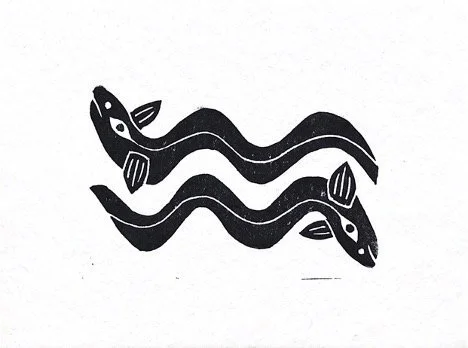
Cover art by Dawson Stout.
Masthead
Editors-in-Chief: Leon Sebastian Barros and Natalee Cruz
Editorial Directors: Stephanie Berger, Jackie Braje, and Tova Greene
Readers & Editors: Lisette Boer, Fi Makris, and Faith-Marie McHenry
Editor’s Note
Dear Readers,
Recently, someone was walking along the Oregon coast when, in the distance, they spotted an unidentified black mass on the shore. As they got closer, they came to realize it was a carcass. Strewn upon the sand laid a lone angler fish, her football-shaped body blackened from decay, a dried bulb hanging from her forehead. Scientists say this discovery is only the thirty-sixth of its kind; a deep-sea rarity, dredged from the ocean’s depths, a sight witnessed by only a few.
The sight elicits grotesque fascination coupled with melancholy, a visceral reminder of our loneliness and animal mortality. In the issue ahead, animals run wild. Both observed and embodied, some are friendly, some fearful, some feral—some dead. From Indovina’s lovin’ bear to Abigail Swoboda’s thrashing eels, creatures abound, evoking a primal state and offering us an experience different from our own.
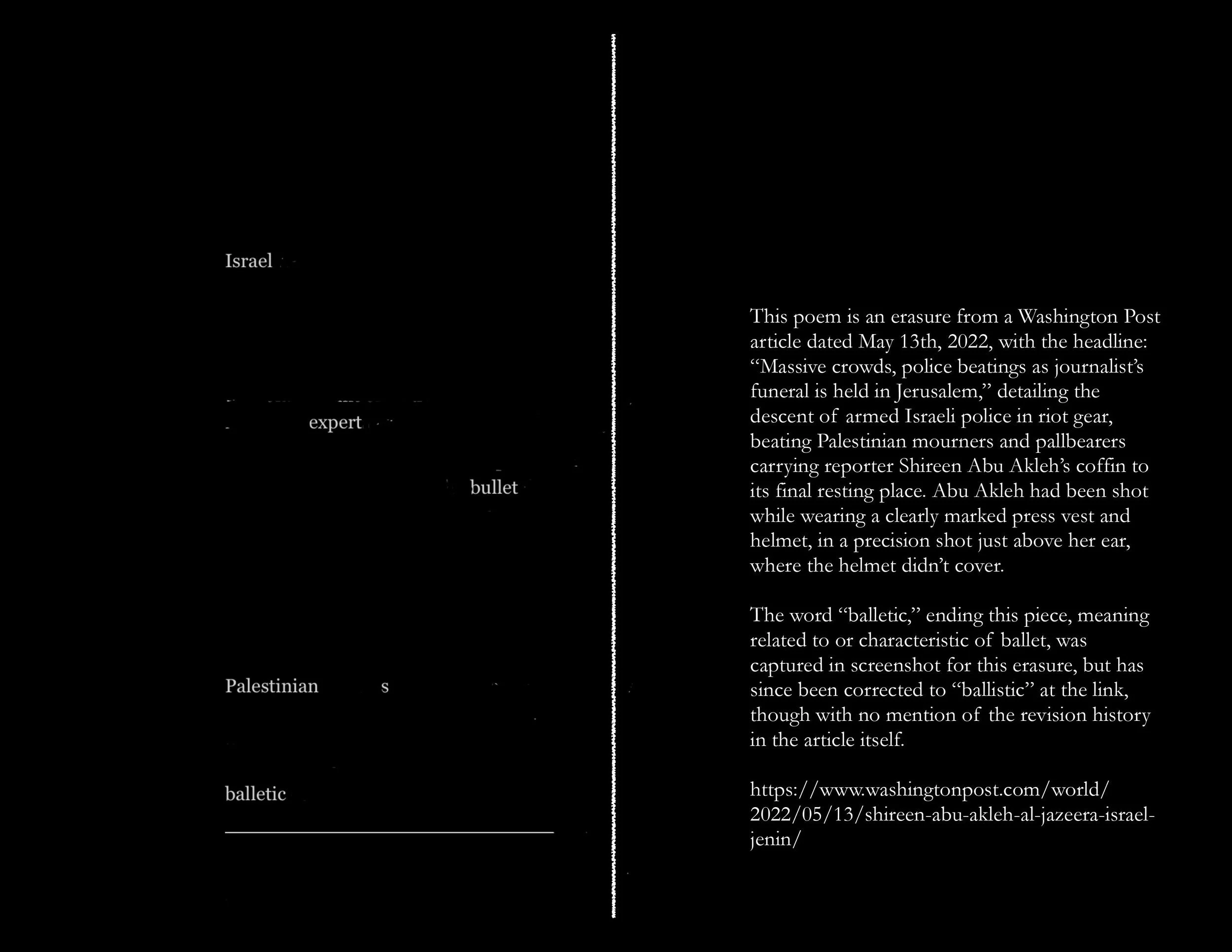
These days, living can feel like an exposed nerve, an animal body that cannot distinguish between itself and the world around it. Certainly, now, we feel this more than ever. As the indescribable violence in Rafah, Sudan, and the Congo and against citizens in Haiti and Uyghur Muslims in China rages on, the pleas for a ceasefire and humane resolution remain unheard. As Bazeed in “Palestinians, Balletic” demonstrates, it’s all too easy to fall into this quiet horror of erasure.
So, what are we left with, and what comes next? Thinking about the angler fish, left on that shore to the caprice of the elements, it is human instinct to be repelled. Yet one also realizes the angler fish did not appear out of nowhere. 3,000 feet below sea level, the angler fish lived in a thriving world, full of its kin and other deep-sea creatures, all trying to live with each other, from birth to death, to survive.
Our contributors remind us that it has always been we who come together to stave off this existence’s cruelty, through family, community, and even through art. As protests around the world continue to show, there will always be people who will defend the right to live, and to fight for a better future, even as some continue to deny it to others. Throughout the issue, these artists speak both to and think of other people, wondering how our animal bodies, in our encounter with the other, can be a source of terror and joy, of violence and love. For all our faults, the problem is the solution: each other.
Perhaps that angler fish can teach us something too about the unknown, that there are worlds and even futures beyond our comprehension, beyond our ability to imagine. In the final lines of “Abecedarian On Surviving | Apocalypse,” Kindall Gant writes, yesterday is today refracted | in the nightmare of yesteryear / zeitgeist of an era we dream real | tomorrow hasn’t arrived yet. Even that angler fish, 3000 miles above, ended up arriving at a strange new shore.
Warmly,
Natalee Cruz
Leon Sebastian Barros
Editors-in-Chief
Poetry

Eleonor Botoman
-
Have you ever met girls made of antler velvet?
They are snow, they are yellowing
broth, hot throats strained by cold air.
Laughter soaked through boiled bones all
mountain sounds with joints that never thaw.These girls are flowers drying on the windowsill,
sliced open bellies hanging in a small house soaked in salt.
The calcium white of dowry lace, the strength of
blankets locked inside a wooden box.When you press your face into her hair you smell smoke,
animals skinned for drum membranes, a rooster spasming
above the the slosh of blood in the bowl and your grandmother
drawing a small knife across the crumpled neck with leather palms.
You watch, containing your breath between the gaps in the fence.I have seen girls made of beast hours.
Under nights that half-whimper out in blued
sputters of campfire, boney fingers pull the furs closer.
Somewhere, there are teeth snapping at the church doorYou are supposed to name your daughters after saints
but these are women born with rifles tied to their spines.
Snow-clots between the toes, these girls are a hound pack
of fever, wombed in the stories of ancient things, mouths so
argent-heavy lapping at your eyes like sparks from striked iron.You are the beast she would like to cut open, to
crawl inside and occupy the shelter of your organs.
In my dreams, Winter is a hungry sister.
Jaws slick as honey, fastened around the kiss of your throat.
-
Eleonor Botoman is a Romanian-American writer and cultural worker based in Brooklyn. Her poetry and criticism has appeared in the Long Now Foundation, C Magazine, BlackFlash Magazine, The Mantle, and The Sunlight Press among others. When they're not researching the impacts of climate change on museums or experimenting with perfumery, you can find them curating multimedia wonders for their newsletter, Screenshot Reliquary and on Instagram and Twitter. You may find more at her website.
-
Stork bite, angel kiss, salmon patch
of blush epidermis, pink palm print
pressed to the back of your head
& hidden until you merged
with the light outside my insides,
summer flooding the hospital room
in the city of Saint Monica, patron
of mothers & famous for cheering
son Augustine along his fraught
illustrious path & isn’t the world
just like that? Mothers versus Death
since forever as we’ve followed it
in history books & life
& certainly since you arrived
on this planet so breathtakingly
artful in its design on evils
& delights, on miracles & mayhem
& shame on us & on me
forgetting your skull cap’s masterpiece,
the field of Rorschach strawberry
where I’d plant my lips so often,
letting your follicle fragrance
fill me, a grace-given thing,
this infant essence, fecund
& flesh-scented, the bread
of stars if they could exhale
like animals, like the breath
of heaven, really, then the unseen
illness, the taking of pictures,
the requisite shearing of locks
grown long in your young
adulthood—I saw it—the good
friends flying in with their weed
& spirits, their laughter
& raucous playlists, the ceremony
of love your goofy lot performed,
first braiding then snipping
then shaving your head to its
nubby minimum so the chemo
could not get there first,
that fucking devil we’d bless
& curse as it snaked its orange
burn around your body
in the coming weeks & months
& how the shearing brought the mark
into view, the rouge kiss of a long-lost
lover peeking through your homemade
beanie knit by a family friend
from the church we don’t visit
anymore, not even on holidays
or to pray in pews under stained glass,
those ocular openings in the Neo-Gothic
vein since medieval Chartres
where divinity streams through—Oh,
you brave & worthy knight,
your body a cathedral, your bones,
holy relics humming the hymns
of coming health & weren’t we
the ones back when, always first
to the healing rail, our heads bowed
to receive the woo-woo spirit
where most were too proud
or embarrassed to kneel or believe
but we knew that the things worth
knowing are not the things we know
& when God is gone it means
church is everywhere & water
might turn to wine & stones to gold
& the greatest moment in the service
was when everything stopped
& the veil of words dropped
like a curtain of hair falling
& the people turned to touch
each other, saying Peace be with you
& Also with you, their trembling
hands a little like newborn
roses opening to morning
after the shadow of night has passed
-
Michelle Bitting was short-listed for the 2023 CRAFT Character Sketch Challenge, the 2020 Montreal International Poetry Prize, and a finalist for the 2021 Coniston and 2020 Reed Magazine Edwin Markham Prizes. She won Quarter After Eight’s Robert J. DeMott Short Prose Contest and was a finalist for the Ruminate Magazine, Sonora Review and New Millennium Flash Prose contests. She is the author of five poetry collections: Good Friday Kiss, winner of the inaugural C & R Press De Novo First Book Award; Notes to the Beloved; The Couple Who Fell to Earth; Broken Kingdom, winner of the Catamaran Poetry Prize; and Nightmares & Miracles (Two Sylvias Press), winner of the Wilder Prize and recently named one of Kirkus Reviews’2022 Best of Indie. Her chapbook Dummy Ventriloquist (C & R Press) is forthcoming in 2024. Recent poetry appears on The Slowdown and is featured as Poem of the Week in The Missouri Review. Bitting holds an MFA in Creative Writing from Pacific University, Oregon, and a PhD in Mythological Studies, emphasis Poetry and Psychology from Pacifica Graduate Institute. She is writing a novel centered around Los Angeles and her great grandmother, stage and screen actor Beryl Mercer, and is Senior Lecturer in Creative Writing and Literature at Loyola Marymount University.
Michelle Bitting

Ally Eden
-
that summer ash ruined
the whole damn sky yellow-bellied
marmots near exterminated & the mountain
lions kept alive on kibble & water
we left outside for them hundreds no
thousands were evacuated we stayed
in cities blanketed overnight
we were dusting earth from our cars
we were worried about people
we breathed whatever fresh air
we could find we could have
saved some for later but
thank god the fire
died & we got
we were
busy -
ALL THIS LIFE PEARLS ON A STRING
the bone-stacked oak a body balancing as an eyelash flutters the planet shakes uncontrollably animals, we believe the quiet miracle of burning stars is the big picture like snow trees & rivers & all things fall back to earth vanish or weary & at our feet disappear but what if in the soft storm of years you flurry out of reach ghost me what if when you die i feel it God & everything the taxonomy of holiness: is just this how glorious fleeting & how brutal -
kids line up at the door
pushing, press against each other’s bodies
until the line is hush, arms. quiet by their own bodies
they wait to be released. on the playground
the play, don’t they? wearing bare a patch of
dirt in the field of green. might-as-well-be-lava
and if they want to be someone
they make-believe, don’t they? and if they vacillate
they are told over & over who to be until
someone yells “shooter” & everyone plays at dying
except the kid accept the kid
who has worn the grass
so thin just by standing there as if they
as if living mattered
-
Ally Eden (she/they) is an emerging queer poet and currently serves as Poet Laureate of Fort Collins, Colorado. Ally’s work is vibrant, unabashedly poignant, and rooted in love for community. In her approach to art as a practice, she strives to curate participatory experiences that offer everyone a seat at the table. Ally co-founded the Gulo Gulo Poetry Collective, runs a bimonthly peer-critique group, The Rabbit Hutch, and facilitates collaborations and workshops for musicians, immigrants and refugees, incarcerated writers, fellow writers, queer youth, and the community at-large. An English/Spanish interpreter by trade, her role as a linguist parallels her poetic ethos—bridging difference by way of words. Ally Eden’s work has been featured in The Imaginables, Nudie Magazine, Scrapped Magazine, and “Songs of Revolution” by Sunday Mornings at the River.
-
Nude and wet as I’ll ever be without fear of harm,
the steam envelops me. A soggy cocoon
of transient remedy. A more regulated drowning
until my breath returns, having ricocheted off the mold.
The curtain sweats out a desire sticky and lingering
as the craving your lovelessness affords.
I am trying to love the way you’ve made me
have to love myself. Permission
with no promise of return.
I open the faucet of us and nothing rushes out.
Mothering is slippery, I know. Lots of need
for grabbing on. For doing as you must.
You recount stories of your own many avoidances.
How you knew to do as told without question. Meaning
all the questions got jammed down from your slightly parted lips
to whatever organ holds the most hesitance
to your bloodstream. Hatching within me.
Now all I have are questions. My insides never dared
imagine being supple and uncalloused. So I gather myself
beneath a constrained downpour in hopes of dissolving,
imperceptibly. In hopes of seeing
what the drain has to offer me. I’d like to believe
there is a sewer for all the lamentations we’ve sloughed off
in anguished showers. A holding place prior to treatment.
Trouble with that is, all water gets recycled. Incessant
is sorrow. Foolish to think we can wade in the same waters
without repercussion, awaiting salvation.
-
Ayling Zulema Dominguez is a poet, mixed media artist, and arts educator with roots in Puebla, México (Nahua) and República Dominicana. Grounded in anticolonial poetics, their writing asks who we are at our most free, exploring the subversions and imaginings needed in order to arrive there. Ayling believes in poetry as dutiful liberation practice, writing against colonialism and toward new worlds of community care, ever-healing lineages, and land returns.
Ayling Zulema Dominguez

Kindall Gant
-
— after Sun Ra's Space is the Place
aliens exist but i’m still alive | in amerikkkabackdrop blue | lives protected more than black
colonization the root of climate change | chronic
deforestation | murder purposely mistaken for death
everyday | another unnecessary angel’s eulogy
for what | seems like will but won’t be forever
generations of grief | seeking god in the genocide
hardened whelmed over by the absence | human
impatience a constant for change | the future imagined
juxtaposing an unnameable | into existing justice
kaleidoscoping science fiction into reality | karmic
light travels us through | years of life-saving liturgies
myth transforms into historical record | missions manifest
new worlds | stardust made non-monolithic niggas name
oppressed folks | their overseers reaped for oblivion
peeled from what was made into what will be | re-write present
quilt belief into the broader tapestry | resurrect it queer
revolution for the masses | a collective re-remembering
subverting middle passage | slave ship turned spacecraft
the instrument prototyping tenderness | isotope teleportation
ultraviolent for the massas who don’t make it | to utopia
virtuosic transitions to an envisioned elsewhere | liminal visions
wage war against erasure | from memory wading in water
xenial alchemy | ancestral end of awaiting a xenagogy
yesterday is today refracted | in the nightmare of yesteryear
zeitgeist of an era we dream real | tomorrow hasn’t arrived yet
-
Kindall Gant (she/they) is a Black femme interdisciplinary poet and New Orleans native based in Brooklyn. She experiments with visual storytelling as liberation through themes of home, heritage and history, bringing poems into conversation with expressive forms like film, visual art, music and photography. They have received support from Cave Canem, the Poetry Foundation, MASS MoCA, the Saltonstall Foundation, the Watering Hole, Studio Museum in Harlem and Ma's House among other arts institutions. Her work has been nominated for a Pushcart Prize, Best of the Net and appears or is forthcoming in Torch, the What a Time to Be Alive zine carried at the Hopscotch Reading Room in Berlin, the 1619 Speaks anthology published by the Sims Library of Poetry, Brooklyn Poets, Obsidian, and Polemical Zine. Find more of their work at kindallgant.com.
-
The girl in the memoir about sexual assault
walks in a cloud of unreality so now
I do too. The empty streets scare her and also
me but she’s learning to get used to it,
to balance a feeling of safety with a desire
to live fully. In my dreams I clench my fist,
reel back and punch with all my force, but
the blows bounce off the man and he laughs.
I grab for his balls, gripping, digging
my nails, but he’s got a kink and it turns him
on. That’s one for the therapist, Peter says
and grabs our glasses for a refill, and I can
picture my doctor, head tossing side to side
lips smacking, as if to say, Yeah, but how
about a problem I can help with. Now I check
my legs, the sweet yellow of a bug bite
grows and distorts. I resist the urge
to go to beauty. I’m sure I’m bored:
the monotony, the surface-level analysis
rubbing the same grooves. I am always
listing things I want and fear. I risk
losing subtlety to polemic. It amounts to nothing
counting every grout line
on the tiled floor, but I appreciate a purpose. In a
film genre coined “old ladies and hijinks,”
famous actresses over 60 are hustled together in
light romps about friendship, sex,
and death. They join book clubs, prank
their exes, learn football. There used to be
no lead acting work for women over 50, then came
hagsploitation, older women
with too-bright makeup smeared onto wrinkles, chasing
someone with a knife.
In a press tour interview, the actress says
it’s more important for the young women.
They need to know there’s something
after all that. They need to know
They can scare themselves
-
Heather Gluck is a poet from New York. She received her MFA from Columbia University. Her poetry has appeared in Anthropocene, Palette Poetry, and Anti-Heroin Chic, among other publications. She is the managing editor of Epiphany and the poetry editor of West Trade Review. See more of her work at heathergluck.com.

Heather Gluck
V Lane Hoy
-
1) Bill sent me home with a box of cake from Veniero’s Pasticceria on 11th Street
2) I tried to convince Carla to take one of the slices, “no it's tied with string,” she
said at first, “I don’t even really like sweets,” she said next
3) I failed to convince her, not knowing her well enough to know how hard to push
4) I enjoyed the privilege of cutting in front of the queue at the zine fair
5) The ego, that perennial source of shame
6) I have a face, the ego seems to say, daily
7) I fill it with cake, with cum, with commas. I am trying to fill it with commitment,
which seems not to be my nature. Then I think I’ve been wrong about my nature,
wholesale
8) Are we, in this life, to push against our natures, or go into them with as much
depth as we can bear?
9) Would doubling down on my sort of masculine waifishness please god?
10) Or is it better to struggle against the impulse to live like a leaf blown into water,
letting anything thrash me this way and that way and taking it?
11) Which would require a more traditional masculinity; thrusting myself into the
seam of each cracking day, with impressive calves that harbor a quiet threat
1) My edges were made of pigeons’ stretched out wings
2) I was entirely penetrable
3) Calling it bravery except if I could have I might have chosen cowardice
4) The orange tone came and went like accents on the train
5) I set up everything wrong for the evening, saw faces from my past, imagined
them smiling at me and found it helpful
6) Hillary stayed with me on the phone for hours, Demo too
7) Jumi prepared to do something I wanted to change her mind about, and wanted
her to change my mind about, and found, with some horror, my mind was maybe
already bent towards hers a little
8) Betraying the part of me that moves with sewing machine precision, admittedly
ungraceful
9) Risking a chance at direct sun, water flooding lungs, ordinary pleasure, swiping
hair from The Other’s face
1) Cranes still in the sky, a heavy chain cranks not at all for the afternoon
2) Am I swaying still?
3) A baby’s eyes are sometimes just like the fathers
4) Are these things I want, suddenly?
5) Meaning more lasting than the watercolor cups I used to probe a paintbrush into?
6) When people say having kids is selfish I think they often really mean having kids
is a shortcut to flattening out the creases of the begging afternoon
7) Should we not permit ourselves shortcuts?
8) Guilt residues on every windowsill along with long perished flies, is what Anna
means by “the obligated life,” the one we risk moving out of in order to really live
9) Should I stop recalling laughing with you in my mouth hardly?
10) Would that be a greater risk, than forgetting?
11) “Risk” in this turning is twofold & opposite; the risk of losing something you need.
The risk of losing something you need to lose to gain what you need even more
12) I want simply to be in the service of even more life
13) I thought of deludingly, craning my neck for another line
1) I did not notice my face slackening like mesh worn into afternoon heat
2) But bus placards offered unfriendly confirmation
3) More tabs were added to the task list by trembling hands only Hillary has held
into stillness
4) Benji’s birds nest veiled me from what I am only afforded to press between my
palms so briefly
5) Say it plainly Eirik says to Lucien and Lucien says to Sunday with an open
question
6) I promise to never again use nature to make up for my underdeveloped
spirituality, I read some version of, and pasted to my wall as a threat
7) My mom loves this long song
8) Like a bass line, you can't always know what a presence is doing for you until it
cuts out
9) Not unlike the hurricane cutting out the lights, Facile running out the backdoor
after a potent line
10) I hollered after him, barefooted, I recall
11) Please, please don't put that on the bright marquee
-
V Lane Hoy is an interdisciplinary writer living in Queens, NY. They earned a BA from The Evergreen State College where they studied critical theory and creative nonfiction writing. Their writing engages with themes of architecture, home & homelessness, affect theory, and how people interact in the public sphere. They’re currently pursuing a Masters degree blending harm reduction principles with public space use and design from the Graduate Center for Planning and the Environment at Pratt Institute.
-
Fuzz and mass as he
Tramples through his wood
Unabashed
After hibernation
His mellow tidings
Sauntering on all fours
Fur untamed
Unbuttoned
Unfurling
Sleepy eyes as he
Jiggles his body
And yawns
And exhales
And scratches
His big belly
His biker’s bliss
With stocky limbs
He lifts himself up
Rubs his back
Against a tree
Can’t reach back there
But who cares
When he’s the biggest
In the landSomeone will come
And undo him
With their sharp claws
And masseur grip
Feeling the way he
Moves at the waist
As he rocks
Back
and
forth
Against
the
bark
His
dance
all
Mo-
men-
tum
His
dance
all
Hypnos
with a
lullaby
at the end
of his spinehe licks his lips
as he gets off
his huge
haunches
heavily
heavenly
hungrily...
I can never keep up with him.
-
Indovina is a moniker for Michael Indovina (he/him). He is a 21-year-old bisexual poet, artist, ekphrasist, and editor from New Jersey. He is a senior undergraduate student at Drew University, double majoring in English (with a concentration in Creative Writing) and Studio Art, while also minoring in Theatre Arts. He is the Editor-at-Large of Insanity's Horse, Drew University's art and literature magazine. Earlier this spring, he was the Assistant Editor for Beatdom Books, where he edited the forthcoming book, The Burroughs-Warhol Connection, by Victor Bockris, and issue #24 of Beatdom literary journal. He is also currently a volunteer editor and layout designer for Pureception Magazine. Indovina's writing can be found in Issue 1 of Chill Mag and in various issues of Insanity's Horse. His Instagram is @indovina_poetry.

Indovina

Krysia Wazny McClain
-
The podcast guest pronounced it queerulous
and that long e turned my mind to mischief,
or mischievious, a misspelling born in the mouths
of 16th century English, kissing its way to my own.
But I’ll text it properly: Look how mischievous I am.
Squirming in my chair, primed for teeny harms
and discomforts. Later she sends me
a screenshot of my name in her phone, spelled so
that the long e is clear, a sound that doesn’t
correspond to its phonetics but to Midwestern ears—
The way I say pink sometimes and it feels
better, pinker. Meanwhile, I’m sinking into
the torturing hour between texts and dates, one week
of NRE’s strange fire stoked and spent on phone banks.
Hang up on me. Hang upon me. Here and here.
-
Krysia Wazny McClain is a poet, writer, and editor from Somerville, Massachusetts. She is a graduate of the Bennington Writing Seminars, and her poetry and criticism have appeared in Porridge Magazine, the Massachusetts Poetry Festival’s Ekphrastic Gallery, and the Colorado Review. She is also an abolitionist community organizer and performs as the sapphic pigeon poet Livia Dove with the Boston Poetry Brothel.
-
arm and arm and arm and
our bodies clinked like wedding china
chipped paint on the edges of our faces
and when they called us broken
we gave knowing smiles and said
well loved and we sang our mating calls
begging to be seen
and loved for it fields dew damp spreading
before us, neck of a wine bottle wagging arm to arm to
arm if the dream catcher says teeth represent
vulnerability we kissed hard mouth to mouth to mouth to
skipped our teeth across each others tongues falling
out of my jaw and into yours and out of your
mouth into theirs until someone
pulled a silver tooth wedged beneath
their paperweight tongue
and asked what do you think we can get
for it? and we all said
more time, more time one more time
-
Bleah Patterson (she/her) is a southern, queer writer born and raised in Texas. A current MFA candidate, writing professor, and TRP publishing fellow. She was a winter 2024 SAFTA Resident. She is a Pushcart nominee and her various genres of work are featured in The Brazos River Review, Write or Die, The Texas Review, Across the Margins, Queerlings, Fifth Wheel Press, Beaver Magazine, and elsewhere.

Bleah Patterson
Visual Art

Bazeed
-
Bazeed is a multi–award winning Egyptian immigrant, poet, playwright, spoken word artist, stage actor, performance artist, and cook, living in Brooklyn. An alliteration-leaning writer of prose, poetry, plays, and pantry lists, their work across genres has been published in print and online, and their plays performed on both sides of the Atlantic. To procrastinate from facing the blank page, Bazeed curates and runs a monthly(ish) salon and open mic in Brooklyn, and is a slow student of Arabic music.
Work
-
This poem is an erasure from a Washington Post article dated May 13th, 2022, with the headline: “Massive crowds, police beatings as journalist’s funeral is held in Jerusalem,” detailing the descent of armed Israeli police in riot gear, beating Palestinian mourners and pallbearers carrying reporter Shireen Abu Akleh’s coffin to its final resting place. Abu Akleh had been shot while wearing a clearly marked press vest and helmet, in a precision shot just above her eat, where the helmet didn’t cover.
The word “balletic,” ending this piece, meaning related to or characteristic of ballet, was captured in screen shot for this erasure, but has since been corrected to “ballistic” at the link, though with no mention of the revision history in the article itself.
https://www.washingtonpost.com/world/2022/05/13/shireen-abu-akleh-al-jazeera-israel-jenin/



Ana Maria Caballero
-
Ana Maria Caballero is a poet and artist whose work explores how biology delimits societal and cultural rites, ripping the veil off romanticized motherhood and questioning notions that package sacrifice as a virtue. She's the recipient of an Academy of American Poets Prize, the Beverly International Prize, Colombia’s José Manuel Arango National Poetry Prize, the Steel Toe Books Poetry Prize, a Future Art Writers Award and a Sevens Foundation Grant. In 2024, she became the first living poet to sell a poem at Sotheby’s and has sold the first digital poem via live auction in Spain. Her Pushcart Prize and Best of the Net-nominated work has been published extensively and exhibited as fine art at museums and leading international venues, such as the Wroclaw Contemporary Museum, Museo de Arte Miguel Urrutia, bitforms, Office Impart, Poetry Society of America, Gazelli Art House, New World Center and Times Square. The author of six books, she's also a founder of digital poetry gallery theVERSEverse.
Work
-
The method of delivery defines
the type of mammal we, they, you,
are. The category of creature I am.
They are monotreme, they who are reptilian,
birdlike in their method of birth. A cracked
white shell announces their first day.
Monotremes possess cloacas. One canal
to expel excrement, urine, and the egg
that descends from within to remain without.
You are marsupial, you who clamber
undeveloped into your momma’s pocket.
Out of differentiated birth canal you arrive
to climb incomplete into her warm pelted
pouch. No one blames you
for this extra time inside.
I who am placental—food and waste
conveyed via same-serving, cloaca-like rope.
Then, cord sliced, tied: belly button bulge.
Initially conjoined, I was cut free upon first breath
alive. An entire lifetime spent nursing
such self-determining slice.
“entropy,” 2023.
Stephanie Cochrane
-
Stephanie Cochrane resides in Brooklyn,NY. She works as a floral designer and creates handmade collage art in her spare time. Crafted mainly from discarded books and junk mail, her work explores the complexities of modern relationships.
Work
Online Dating Profiles


Sylee Gore
-
Sylee Gore is a poet and artist. Her work is exhibited this winter at the Green Door Gallery in Brussels.
Work


Dale Going + Marie Carbone
-
Dale Going is a poet and book artist with two poetry collections and numerous chapbooks, broadsides and artist's books. Her work has received support from Fund for Poetry, California Arts Council, Yaddo and Djerassi. Her Em Press letterpress editions of poetry by women are archived internationally in prominent library special collections. Recent poems appear in VOLT, New American Writing, Blood Orange Review, Banyan Review, Equinox, Griffel, LandLocked, Nelligan Review, Stone Canoe, Wild Roof Journal, BRAHM and Fenimore Museums. A new chapbook is forthcoming from Albion Books. She lives in Manhattan and the Adirondack Park. www.dalegoing.com
Marie Carbone is a multi-disciplinary artist. Her collage art has appeared in galleries, journals, books, broadsides, and as projections for performance art. As a classical pianist/harpsichordist, she composes soundscapes for film, theater, museum exhibitions, modern dance and ballet. Her particular interest as an educator is in forefronting the music of women composers. She lives in Sausalito, CA.
Work




Devon Grimes
-
Devon Grimes is a Brooklyn based painter and creative. Raised in Virginia, Devon holds a BA degree in oil painting from the University of Virginia. When she's not painting, she frequents acting classes and poetry readings. On the weekends, you can find her at the BKFlea where she sells prints of her works.
Work
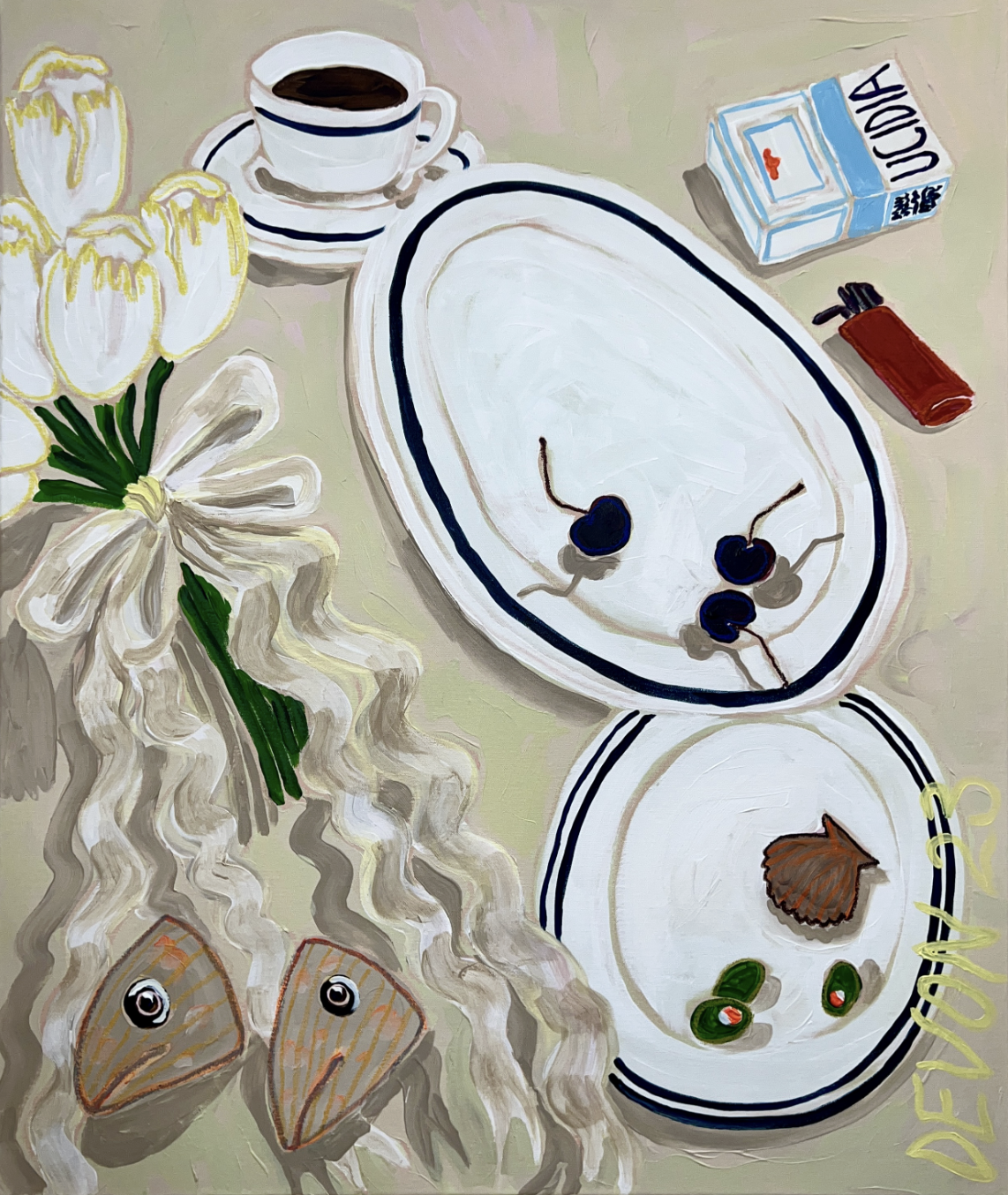


Gabriel Morgan
-
Gabriel Morgan is a multi-disciplinary visual artist and writer who lives in Brooklyn, New York. He is the author of one book of poetry, titled “Rodeo Wasteland,” published in 2021. He can be found online at @strangeluckfrog.
Work
2024. 11 x 14. Graphite on Paper.
Sweetgum

Dawson Stout
-
Self-taught, American artist Dawson Stout came to painting unexpectedly during the pandemic in March 2020. Holding a masters of science in landscape ecology and environmental monitoring, he often uses his art as an extension of his academic background to explore our human relationship to space and the ways that our own psychologies merge and interact with the world around us. How can we visualize an internal landscape as a physical one? What is the “self” other than an impression of constantly changing external environments? Despite the paranoia this might spur, he questions what it means to be “alone” in landscapes so rich with life and how we might learn to appreciate the transient, interconnected, and absurd experience of living.
Born in Denver, Colorado, Dawson grew up outside New York and currently works in Berlin, Germany. His work has been shown internationally alongside artists including Joseph Beuys and John Paul Fauves. Recent honors include selection for a juried exhibition hosted by the assistant curator for the Solomon R. Guggenheim Museum and publication in MILK Press. You may find him on Instagram.
WOrk


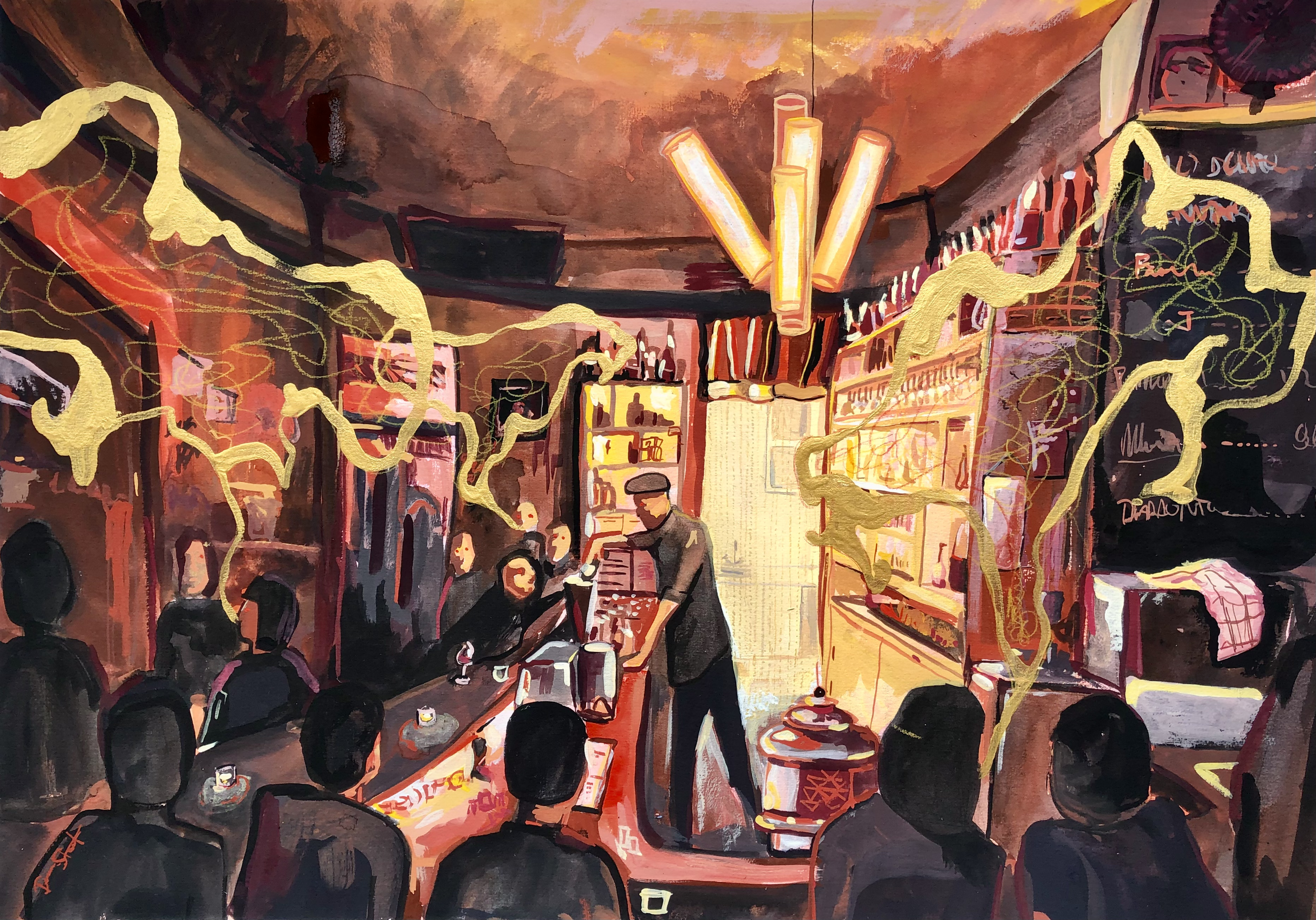


Abigail Swoboda
-
Abigail Swoboda is an interdisciplinary artist from Pennsylvania. Their collections include REVELATION REVELATION (Bullshit Lit, 2023) and VISCERA AMERICANA (Thirty West Publishing House, 2021). Visit their website abigailswoboda.com or find them on Instagram @beetrootstock.
WOrk
-
1
The season of Hell is shifting
from Fire to Water.2
Across a fathomless ravine, we all watch
as our new city builds itself slowly.3
The skyscrapers that were once
there have begun to sink back into the ground;
now, a walled stone city is emerging
in their place.4
The construction of this stone
city is driven by an immense orgy
that hums at the edge of the city.5
Incest heats the orgy that is the engine
of our slow creeping into the past;
cousins embrace cousins; brothers
embrace brothers; sisters embrace
sisters; all bodies are
slick & pink.6
I walk out to the edge
of the ravine to see the tops
of the sunken skyscrapers;
they have almost entirely absorbed
back into the dirt.7
There is a man there, at the edge.
He sits cross legged on the deserted road
that drops off into nothing at the ravine.8
The man does not move;
he is unaffected by the shifting
seasons.9
I come back day by day, to the edge.
10
I see the skyscrapers sink & sink,
until they have never been
at all.11
The man does not move.
12
The orgy rages.
13
The stone city emerges
fully from the past.14
Then, the season of Hell shifts &
the ravine fills with water & becomes
our bridge to the stone shelter of our past.15
We all celebrate the season
of Water & we prepare ourselves
to cross over to our new home.16
The water between us & our stone city
churns & crests. Where it is not white,
it is a blue that is almost black.
The water is filled with eels.17
The eels in the water thrash
in wild shapes at the surface.
The eels appear to us only in parts:
a fin; a tooth; a gleaming eye.18
We begin to cross; we are still
able to fly, but it gets harder as we get farther
along. We get closer to the water as we go.19
When my toes begin to skim
the water, a concrete median appears
in the middle of the passage.
20
The concrete median bisects the water
parallel to the two sides of the ravine,
splitting it into two equal halves.
21
I rest my body on the concrete median;
I watch the eels thrashing in the water;
I am now alone.
22
I can no longer fly.
23
As I swim, the eels twist & turn against
my body; their electricity prickles my skin.
24
I reach the other side of the ravine.
25
On the other side, there are two archways;
both lead into the same restaurant.
26
The restaurant has orange walls
& wet tile floors. Someone waits
behind the counter at the end
of the hallway.
27
I pull my body out of the water
& enter through one of the arches.